Showing posts with label 暖房. Show all posts

Tuesday, 15 June 2021

Thinking of Getting a Wood Burning Stove?

There is something magical about wood fires, and people are often tempted to put them into their houses. In writing on low energy building, I haven't really talked about wood burning stoves. People sometimes ask how you can fit a wood burning stove in a low energy building, but the question you first need to answer is: why do you want a wood burning stove?

Before you get one for your house, and especially before you plan to build a new house around a wood burner, you should check that you meet at least four or five of these seven criteria. You don't have to meet all the criteria, and in fact some of them may contradict each other. But you should meet most of them.

1. You have a sustainable source of wood.

Perhaps you live in a forest, or a relative has an orchard, or you live next to a timber yard, or you just inherited a derelict warehouse with a large collection of broken pallets. If you don't know where your wood is going to come from, then you will need to buy it. You may have thought that wood grows on trees. In fact wood does grow on trees, but those trees grow on land, and that land usually belongs to someone. The trees also play a major role in creating habitat for wildlife, and are acting as a sink of atmospheric carbon and a source of oxygen. 

Well-managed forest can provide better habitat for wildlife and can provide more effective carbon sinks, but burning wood will send some of the carbon that has been stored over the last decades or centuries straight back into the atmosphere. Even if the forests are well managed, burning the wood that grows there may not be the best use of it. If left on the forest floor, wood can provide excellent nutrition for the forest and habitat for some of the diverse life there. 
Not really firewood!

So wood may not be the best fuel for your house in terms of economics or ecology.
 
Or it may be the best thing in terms of economics and ecology. 

I don't know the answer, but if you're thinking of using wood, please find out!

2. You like chopping and storing wood, making fires and cleaning stoves and chimneys.

Having a wood burning stove is a lifestyle choice. That's another way of saying that it will take more time, cost more money and may be worse than the alternatives in various other ways. Wood needs to be chopped and stored where it will stay long enough to dry out, but not too long in the same place where it will attract insects and other undesirables. If you only occasionally want to burn stuff, it may be better to go camping. There are some great campsites that allow you to have a fire!

3. You have no neighbours.

You may be planning to go off-grid, which is a great idea if you live away from civilisation, and this may go hand-in-hand with the first criteria. If you are in a residential area, your neighbours may not appreciate smoke getting into their washing. This article in the Huffington Post suggested that the most efficient wood-burning stove will put out the same levels of pollution as 18 diesel cars. Would you like a fleet of cars driving around your neighbourhood?

4. You are going to get the most efficient model available, with a properly installed chimney.

Benjamin Franklin did make significant improvements to stove design back in the 1700s, but even in the 1800s wood burning stoves were only 30% efficient. They sent out particles at levels that would be illegal today, and allowed creosote to build up in chimneys, creating a fire hazard.

Things have got better since the 1800s but even the most efficient wood burning stove will only burn wood at around 80% efficiency. 

5. Your wood burning stove can run on pellets.

Part of the problem is the wood itself. It seems that wood was not designed with burning efficiency as the first priority. Wood pellets provide a more even fuel and allow higher efficiency. Many wood pellets are currently made from sawdust or waste wood products. There are also pellets made from grass cuttings. If demand increases, wood will be cut directly to make pellets, which may remove some of the supply-end energy efficiency, but they will still burn cleaner. 

More efficiency means more of the wood is turned into water and carbon dioxide, rather than other more polluting substances or unburnt particles or residues. So more efficiency means less pollution and less cleaning. Air quality is an issue in many places, and burning wood certainly does not improve it.

You may consider a dedicated pellet burner, which will be easier to clean, and easier to use since it feeds the pellets via a hopper and may be controlled by a thermostat and a timer. It will probably be cheaper to install since the unit usually has a heat exchanger so a simpler chimney can be used. If you're still wondering about the answer to question 1, wood pellets could be your answer. 

6. You are only going to light your stove a few times a year, and are mostly getting the stove because it will look nice in your living room.

If you're thinking of adding a wood-burning stove to a ready-built house, you may not need to worry about this question. But if you're building new, I recommend your first priority to be insulation rather than burning wood.

Depending on your climate, if you have a well-insulated house, most wood burning stoves will make your house overheat, except on the coldest few days of the year. Your well-insulated house should also be airtight, and this may not be sensible if you are burning wood.

7. You know that if burning wood was the best way to stay warm, everyone would still be using it.

Most of us no longer send telegrams, spin yarn on spinning wheels, or nip down to the local smithy to get a horse shoe fixed. We stopped doing these things because of new technology that is cheaper and more time-effective. Burning wood will likely be more expensive and more time consuming than the options. Wood was our first fuel source; if wood produced more energy than fossil fuel reserves, we would never have deforested vast areas of the planet to mine coal or pipe oil and gas. 

There is an old saying: if God had not intended us to burn wood, he would never have invented matches. Actually that's not an old saying at all, I just made it up. But there is something natural and wholesome about a wood fire. 

Burning wood is better for the carbon cycle than burning fossil fuels. However, it may be better to burn nothing. If you want to avoid or reduce fossil fuel use, the first thing you need to do is improve your insulation. Then it may be better to electrify your heating, which allows you to use renewable energy. 

If you see yourself as an eco-warrior and see fire as one of your weapons against the machine, then be aware of the possibility that with fire you are fighting against ecology rather than fighting for it! I know in the situation we are in, the choice between wood burning or electrified heating may be something like choosing between a bicycle and a skateboard as you prepare to go over a waterfall. 

I don't have all the answers, but I do have the questions! 

So how did you score? If you answered yes to most of them, you're good to go. If not, I recommend looking into heat pumps, either in self-contained air conditioning units, or producing hot water for radiators or underfloor piping.

Remember, taken in moderation, wood burning stoves can form part of a calorie-controlled energy diet for your planet!

References:

If you want to get a stove, go to Michael's Stove Shop.

For recent developments, analysis of factors that effect efficiency and a call to get below 1g of particulate per kg of wood, see "Performance history and further improvement potential for wood stove" by Øyvind Skreiberg & Morten Seljeskog (2019) in Chemical Engineering Transactions, 65. pp. 199-204.)

More details from the US Office of Energy Efficiency and Renewable Energy: Choosing and Installing Wood- and Pellet-Burning Appliances

Chapter on Energy Return on Investment (EROI) of Different Wood Products by Zdravko Pandur, Marijan Šušnjar, Marko Zorić, Hrvoje Nevečerel and Dubravko Horvat (2015)

Friday, 31 March 2017

How do you heat a passive house?

Some people may think the answer is "you don't," but Passive houses do need some heating. 

The real answer is that you don't need very much, so it's not so important how you heat it. 

A comprehensive discussion can be found here from Zehnder Passive House, listing the pros and cons of each approach.

My personal favourites at the moment are underfloor heating and air-source heat pumps, athough I have not always thought so, and cannot guarantee that as a final answer. 

I wrote about underfloor heating before, highlighting the advantages: saving space, evenly distributing heat and increasing thermal mass; and also warning of the problems that can come from incorrect design and installation. One disadvantage that I forgot to mention is that it's very difficult to get to the underfloor pipes if something goes wrong with them, although they are just pipes and it's very unlikely that anything will go wrong.

Air conditioning units are becoming standard installations in Japanese houses, and their COP is getting better all the time. As well as cooling, they can reverse the circuit to heat air. In a regular house using these for heating can be uncomfortable since they are only heating the air, while the building itself stays cold and the temperature is not balanced. In addition, the hot air can rise giving you cold feet and a hot head when you stand up. This may also be an expensive way of heating your house, and it may even be both uncomfortable and expensive. 

Since a passive house has such low heating demands, modest air conditioning units can easily provide the heating needs of a building. The peak heating load of a Passive house should be around around 10 Watts per square metre, so for a 100-square-metre house, you need 1 kW. Units are typically rated at several times this, so one air conditioner can produce all the heating or cooling you will need for a whole house, although you may have to think carefully about where to put it. It can go on a wall or ceiling so, similar to underfloor heating, it won't take up any floor space. 

An additional advantage of an air conditioning unit is that it can also cool the house, and may also have a dehumidifier. The units are stand-alone, rather than incorporated into the ventilation system, so they may be less complicated. And depending on where you are, you may get something that comes with a guarantee, and can be easily be maintained or replaced.  

And by the way, if you're in Japan trying to work out how to read the symbols on the remote control so you can use the air conditioner this post from Surviving Japan may be useful.

Friday, 17 March 2017

Woodburning bad for climate

It turns out that burning lots of stuff is not good for the environment.

According to BBC News from 23rd February, 2017, converting coal power stations to burn wood that has been processed and shipped half way around the world has not reduced carbon emissions. In theory the carbon from trees is released when the wood is burned, and will be taken up by new growth. In practice a lot of forest is being clear cut to export from the US to the UK. This is not counted in the UK as a carbon emission because burning wood is considered carbon neutral, and the carbon is counted when the trees are harvested. In the US, on the other hand, carbon is not counted when the trees are harvested, so this carbon has vanished from the accounting system.

People who are against action on climate change will say, "I told you so", and hold this up as an example of the stupidity of environmentalists.

Environmentalists who have been saying that biofuels are not really the answer will also say, "I told you so", and hold this up as an example of commercial interests missing the point. 

Burning wood in power stations is not progress. This should be no surprise. If burning wood was so great, we would never have started burning coal.

Also there have been recent claims that poor air quality in London is due in part to the increase in wood burning stoves, so the evils of wood burning have become something of a meme.

The key is probably in moderation. Burning lots of stuff is not good for the environment, but wood can be part of a healthy calorie-controlled energy diet.    

Wednesday, 8 February 2017

Heating on and on heating

We turned the heating on 29th November last year, a couple of weeks earlier than last winter, but close to the normal time. It had snowed the week before, and there had been rather too many of the kind of November days you get in England.

The underfloor heating goes on from 8 to 8:30 then from 9 to 9:30, and a week later, according to the T and D thermometers we have in the slab, it's now about a degree warmer at the top than the bottom.
Underfloor heating, called radiant heating in the US, seems to elicit strong emotions, both for and against. In the building pantheon, it is a god for some, and a devil for others. 

There seems to be a strong sentiment among Passivhaus proponents against underfloor heating. I don't think it's completely logical. 

Certainly badly implemented underfloor heating has problems. Typical mistakes are: 

1. Only heating part of the floor
2. Not insulating the other sides
3. Setting the temperature too high
4. Using the wrong floor materials
5. Not having a thick enough floor
6. Not distributing the heating elements evenly
7. Incorrect dimensioning
8. Using electricity

If only part of the floor is heated, the heat will obey the second law of thermodynamics and go to the part that is not heated. Our neighbour has underfloor heating in the living room, but it is in the slab which also runs under their garage. A significant amount of the heat they put in will be trying to heating their garage.

In a Passive House the first two problems won't happen, as long as the heated floor is within the thermal envelope. Since the heating demand is low, there should never be a need to set the temperature high. 

The advantages of underfloor heating are:
Underfloor heating visible before the walls went up
1. There is no need to add radiators or any other heating devices that will take up floor space and wall space, attract dust, produce noise and may leak.
2. The heat is evenly distributed, and will radiate through the whole building.
3. Underfloor heating may increasing the thermal mass of the building and store heat.

Here's a picture of our underfloor heating, but it had to be taken before the screed floor was poured. There is usually nothing to see, unless you have a thermograph. You can see in the picture below with a temperature difference less than 5 degrees. 

26 degrees enough to heat a Passive House
So why do the Passivhaus people seem to be so against underfloor heating? It may be partly sticking to the Passivhaus ideal that the house can be heated only by warming the incoming air. In that case why is there no similar disparaging of radiators? All you need for underfloor heating is a boiler, and in fact most houses have one of those for the domestic hot water. Where do you think we get our hot water from... the kettle?

Since the temperature for underfloor heating doesn't really need to be above 40 degrees centigrade, there are lots of other options for a heat source, such as ground source heat pumps or solar thermal. With the low heat requirement of Passivhaus, a slightly oversized domestic hot water supply should be able to cope with underfloor heating in its stride. Typical boilers use power in kilowatts. The heating requirement of a passive house is of the order of 10 Watts per square metre.

There may be more technical arguments against underfloor heating, regarding the efficiency of the heat transfer. All heat losses are within the thermal envelope and will end up eventually heating the house anyway. If you're in a poorly insulated house where you want to quickly make a room warm while you're there, and not waste too much energy keeping it warm when you leave, then you may not want underfloor heating and its inherent thermal mass. Passive houses are designed to stay at an optimum temperature, and heating is not a quick fix for comfort on demand, but keeping the thermal envelope topped up.

Compared to radiators, underfloor heating probably requires a more powerful pump to circulate the heating fluid since there is a greater resistance. But pumps draw negligible power compared to the heat they deliver. 

This article from Buildinggreen.com gives four reasons for underfloor heating being the wrong choice in low energy homes. If you're ripping up the floors of an old house to put underfloor heating in, it's going to be expensive. But if you're putting some pipes in while you pour a screed for a tile floor it may be no more expensive than radiators. The piping may even be cheaper than for radiators since all the pipes can go into the floor in the same place, while each radiator will need its own pipe. 

The argument against overheating in houses with high solar gain may be more pertinent. However, passive houses don't need the heating on for twenty-four hours, so the heating could be switched on after the sun goes down. There should be no problem with solar gain then. And it can still be switched on for those winter days when there is no solar gain.  

Perhaps some powerful character within the Passivhaus movement had a bad experience with underfloor heating. Maybe he tried it once and got burnt, sitting on an overheated floor with his pants off. 


Tuesday, 8 December 2015

2015: Hottest year on record

Yes, 2015 is the hottest year on record. It's official! Admittedly my records only go back three years. But this year is definitely the hottest!

Usually we switch on the heating 1st December. This year it's already a week later and we haven't thought about switching it on yet. It doesn't feel like we need it, but maybe that's just us getting hardy? 

With sixteen thermometers built into the the house, recording data for the past four years, it's possible to actually check the data. Numbers don't have feelings!

I looked at just three temperatures: the centre of the slab, the south-west corner of the slab, and the north-west corner of the slab. The slab is something like seventy centimetres deep, so there is a big different in the fluctuation of temperature from top to bottom, and up to a couple of degrees difference in actual temperature. The temperature at the top of the slab can vary by up to half a degree in a day, while at the bottom it's more like half a degree a week. 

As of 8th December, the middle of the slab is warmest, currently around 23 degrees. The South West corner is a couple of degrees cooler, around 21 degrees, and the North West corner is a few degrees cooler still, around 17 degrees. This is near the front door, and that's another story. 

As the temperature outside rises and falls, the temperatures inside slowly follows, heat making it's unassailable journey from hotter to cooler. The North East corner of the house gets cooler quicker, less affected by the sun, and more affected by outside air. The centre of the house is slowest to cool, surrounded by all the thermal mass of the concrete. In the summer it is the slowest to warm up.

Looking back over data for the last three years, the house was at the same temperature on 16th November 2014, 13th November 2013, and 20th November 2012. That's around three weeks earlier. 

The threat of global warming threatens increased flooding, extreme weather conditions and climate disruption. A reduction in my already very small heating bill may offer a silver lining, admittedly a pathetically thin one that may not help people who have to cross their living room by dinghy. I may be able to buy a new paddle for my dinghy. 

Friday, 11 September 2015

How much heating does the house need? Part 2: like, how much money does it cost?

The question of how much the heating costs is more straightforward. The electricity bill is the only payment for heating, and the heating only comes on at night time, so I don't have to worry about the cost of my solar electricity.
The electricity bill is all thrown in together so I can't just isolate the cost of the heat source, and even if I could, the same system is used for hot water and heating, so it would be difficult to separate those two costs.

We need to look at how much the electricity costs when the heating is off, look at how much it costs when the heating is on, and the difference is the heating cost. Simple enough, but there are a couple of questions.

First, the hot water is generated by an atmospheric heat pump, which takes heat from the nighttime air. It will use a lot more energy to get heat out of the winter air, when it drops ten below zero for a few days, than to get heat out of the summer air, which sometimes stays over 25. In other words, part of the extra cost of electricity in winter is for the hot water rather than the heating. Also the incoming water will be colder in winter, so it will need to be heated up from a lower temperature, and use more energy still. How much of the extra cost in winter should be attributed to the extra cost of hot water?

On the other hand, the hot water tank and pipes are in the house, so some of the hot water heat is going to be helping heat the house. Should that be taken into consideration?

Another thing that may make a difference is that fact that we pay different amounts for electricity in the day time, at off peak time and at "at home" time, and we pay nothing for electricity if it comes from our solar panels. In the winter it may be more overcast in the day time, so while that electricity would have cost us nothing on a sunny summer day, in the winter they may have charged us 24 yen per kWh. In the summer, when the heating is off, we only buy one or two kWh of day time electricity, but in the winter it's more like eight or nine. Is this going to matter or will it just be a few hundred yen a year?

We use about ten times more electricity in the morning and evening "at home" times, and three times that off peak, so imported day time electricity is only one or two percent of our total.

The second question is easier, so I'll answer that first.

No. Heating cost should just be the energy used in the heating equipment. 

Here are three estimates with different answers to the first question, starting high and pessimistic, and finishing low and optimistic. Each estimate is based on two or three years of data and rounded to the nearest 100 yen. 

1. The no-heating cost is estimated from the months of June to September, when heating is not needed. This is multiplied by twelve and then subtracted from the annual electricity cost.
20,800 yen per year
This will not take any account of extra winter costs for hot water, and will include the incidental heating costs that I just said should not be included.

2. The no-heating cost is the average of the months of April to November, when the heating is off. This is also multiplied be twelve and subtracted from the annual electricity cost.
12,500 yen per year
This is not as pessimistic as the first figure, but it is still treating some of the incidental costs as heating costs.

3. The no-heating cost is the average of April, May, October and November, the colder months when the heating is off. This is subtracted from the bill for each month when the heating was on, then an annual heating cost was added up and averaged.
3,600 yen per year

Our monthly electricity bill is the lines at the bottom. Can you see the heating on it?
I could probably try a bit harder and get an estimate that would be paying me to heat the house. Or, I could round it to one significant figure and call it around 10,000 yen. 

Wednesday, 9 September 2015

How much heating does the house need? Part 1: Primary Energy Factor

Heating load is one of the requirements for a passive house. Although the passive house standard does not eliminate heating, it severely limits the total amount of heating needed over the year, or the maximum needed at the coldest time of year. The limit means it is possible to heat a passive house just by adding heat to the incoming air with no central heating or other equipment. We have underfloor heating, but the house still meets the standard, which is 15 kilowatt hours per square metre per year.

After over three years of living in the house, we should have some idea of whether the actual performance of the house is the same as the simulation. The total primary energy use is easy to work out, and it is in the same ball park: 106 kWh/m2a compared to 94 in the simulation. All our energy is from electricity, and it is metred, so we know exactly how much is being used. To find the primary energy, you need to multiply the electrical energy by 2.7 to account for inefficiencies in power stations and transmission. 

"2.7" is the primary energy factor. This number may vary depending on where your electricity comes from, but the number in Japan seems to be the same as for the EU as a whole.

The Passive House simulation, and my measured calculation is assuming that all our electricity comes over the grid, mostly from fossil-fuel power stations. Around 80% ours does. The other 20% is from our solar panels. Since they are only on the roof, the transmission losses are low, and they are not burning any fossil fuels, so their running primary-energy costs are zero. We do have to pay back the primary energy used in their manufacture.

It's difficult to find a definitive list of primary energy factors. Development of the Primary EnergyFactor of Electricity Generation in theEU-28 from 2010-2013 gives some answers, not strictly relevant to Japan. The figures it gives are more useful as averages for the EU as a whole. This Leonardo Energy confidential report from July 2011 shows a range from 2 to 3 around Europe, and gives a primary energy factor for photovoltaic power in Poland as 0.7.

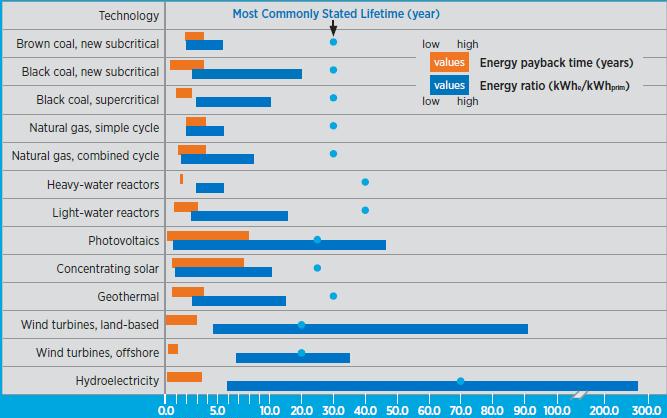
The Centre for Alternative Technology has a few more ideas on this, suggesting a square metre of panel used 250 kWh of energy to make, in 2004-2006. They also note that production goes up, and efficiency increases year on year. We should probably double this figure to account for transport and installation, just to be pessimistic. In a 30 year lifetime, each square metre of my panels will produce something like 7000 kWh, around fifteen times the energy to manufacture. So the primary energy factor is about 0.07. The Energy Skeptic has more information on this.

Graph from IPCC, via Energy Skeptic

We can place the primary energy factor at an arbitrary point between 2.7 and 0.07 and get the actual primary energy use to be the same as the simulated energy use.

It may be more sensible to accept that the simulation used the figure of 2.7 for all the electricity, so we should use it with the actual figures too. And we can easily explain the difference between the simulation and actual figures by the amount of hot water we use, which in bath-loving Japan is higher than the shower-based European figures.

Whichever way you look at it, this house uses less primary energy than the Passive House standard of 120 kWh/m2a.


Edenhofer, O.; et al., eds. 2011. IPCC Special Report on Renewable Energy Sources and Climate Change Mitigation. Cambridge, UK, and New York: Cambridge University Press.   http://srren.ipcc-wg3.de/

Tuesday, 17 December 2013

When did we turn the heating on last year?

Ask the slab. 

We have ten thermometers in the slab, recording and logging the temperature every few minutes. There are five buried at the bottom of the foundation, one near each corner and one in the middle, and another five in the screed, hopefully a safe distance from the underfloor heating pipes so that they are measuring the temperature of the floor and not just the pipes. They should give us an idea of when the heating went on though.

The best one to look at is probably the thermometer in the middle of the floor. Before the heating went on, it was nicely cycling day to day with the temperature at its lowest mid-morning, then rising from 10 or 11 am, as the heat of the sun found its way into the slab. The heat either does this directly by hitting the floor and conducting through the tiles and concrete, or indirectly by heating the air in the house, and the air heating the floor. My instinct is that solar radiation is going to have more effect heating the floor than ambient air, probably because I've been indoctrinated into the mantra of hot air rising, and the consequence that not much heat will be going down from the air into the floor. 

The data is a bit grainy, since we only have precision to a tenth of a degree while  James Joule reckoned he could measure the temperature of his beer vats to 1/200 of a degree Farenheit. Making the best of our 21st century tools, the floor seems to stop warming around 3.30, which is about when the sun stops reaching it directly. The room temperature is still a couple of degrees warmer at this point, but can be five or six degrees warmer around noon. Hopefully you can see this in the first chart, where the green line is the room temperature, the red line the temperature just under the floor, and the blue line the temperature at the bottom of the slab. Of course a bigger temperature difference means more heat would be conducted from air to floor, and in fact the ambient thermometer is half way up the wall on the south side of the house, so it's possible that the air temperature at the floor is only above the floor temperature until 3:30. Anyway, this is not strictly relevant to my question. 

On 5th December, we must have switched the heating on from around 5:30 am because the slab started to heat up then. From then, depending on the weather, there's a double peak effect when the morning injection of heat starts wearing off and the solar gain hasn't kicked in yet. 

On some days there was obviously no solar gain, and the temperature just falls after the morning boost. This happened on December 8th, 9th and 10th when there was a fair bit of snow. 

Then from 12 December we get a triple peak effect when the heating was also on from 7:30 or 8 pm for half an hour. This only lasted for a couple of days, perhaps until my Yorkshire genes got the better of me. 

The triple peak starts up again from 19th December, this time the heating going on from 10 pm for half an hour. 

We went away from 22nd December for 2 weeks, leaving the heating off. The screed went back to the diurnal cycle, with the temperature at the bottom of the foundation plumetting to an all-time low of 19.2 degrees centigrade. The lowest trough in the screed was 18.7 degrees. 

The heating went back on again in the mornings from 3rd January, and I can't tell exactly when it went on in the evenings. There is a rise in screed temperature around 8pm on 7th, 24th to 26th and 30th Janary, and 2nd, 3rd and 8th February. On other days there is a slight plateauing of temperature around that time, before the fall over the night, so I guess night time heating was on at least until 16th February. There are a couple of days when the heat went on around 10:30 pm.

We turned the morning heating off on 8th March, and just turned it on again 12th December. Instinct once again tugs at my coat tails, urging me to switch on the heating so the house doesn't lose too much heat making it more difficult later. Knowledge of thermodynamics suggests that making the house warmer is just going to mean losing more heat, so if we can survive the temperature, we should be OK. Experience also shows that it's not going to get that cold. It was still above 18 degrees in the middle of the slab with no heating on for two weeks at the end of December. Also, experience of the underfloor heating is that the response is not so bad, and while it doesn't give the instant blast of hot air you get from a fan heater or air conditioner, it feels warm within ten or fifteen minutes of switching it on. And if things get really desparate we can switch on the air conditioner, or do something really drastic like put socks on.

Whether to turn it on in the mornings or evenings is another question for another day.

Monday, 7 October 2013

A random assortment of websites relating to solar power

Here are some links to sites about solar power with varying levels of relevance to each other and the real world. Actually a lot of the links are not even about solar power but at some point they seemed worth keeping, so it's just possible somebody else may find them useful. They are all working at the time of posting, although I had to throw a few out of the longer list I had before.

There's a slim chance that somebody who reads this may find one of these sites interesting, and I'm not sure whether to press the send button, or delete.

This is Chofu's Solar heater (in Japanese) http://www.chofu.co.jp/

Here are some water tanks (also in Japanese) http://www.fujitaka.com/

This is about heating in Passive Houses. http://www.passivhaustagung.de/Passive_House_E/

Not really connected to solar power, but here's a company in India supplying phase change materials: http://www.pcmenergy.com/

Here's a paper about using solar water heating with phase change materials, actually making the last link relevant. Anant Shuklaa, D. Buddhib, R. L. Sawhneya, (2009). Renewable and Sustainable Energy Reviews, 13(8), 2119–2125. linkinghub.elsevier.com

And another one from Atul Sharmaa, V. V. Tyagib, C. R. Chena, D. Buddhib, (2009). Renewable and Sustainable Energy Reviews, 13(2), 318–345 http://www.sciencedirect.com/science

Friday, 27 April 2012

The final piece of work - a pricey towel rail

Here is the last piece of contracted work within the house. Apart from a few other bits that we're going to be doing over the next couple of years. And of course the things that were not done properly in the first place and need fixing. 

Technically speaking it's a radiator, but most of the time it's just going to function as a towel rail. We managed to get through the first winter without it even being there, so I'm not sure whether we'll ever switch it on, or if we do, when and for how long. Perhaps it can go on for half an hour on winter mornings to make the changing room toasty after an early morning shower.

One useful feature is that the socket is 200 volts, rather than the standard 100. This means, with a plug adaptor, I can charge my UK mobile phone.