More about ventilation, including mechanical ventilation with heat recovery.
Showing posts with label 熱交換換気. Show all posts
Showing posts with label 熱交換換気. Show all posts
Tuesday, 15 December 2020
Friday, 15 September 2017
Too Much Humidity
When we built the house I refused to add an air conditioner for two reasons. First because I didn't think we needed to spend money on cooling when the house was not going to be so hot, and secondly because I'm from Yorkshire where we don't use air conditioners. Actually that's probably just one reason.
 It may be global warming, acceptance of reality or weakness to luxury, but I think we need take active measures to remain comfortable in the peak summer heat. I need to take a closer look at passive house and high-temperature high-humidity in a different post.
The temperature is not a huge problem. It rarely goes over 28 degrees, and when it's 35 degrees outside, 28 degrees is a relatively pleasant temperature. The problem is when it is humid, and when it gets over 70% humidity it starts to feel really hot.
A de-humidfier would make the house more comfortable without making it cooler. In terms of thermal efficiency, de-humidification is a good idea since heat gain depends on temperature difference, so taking moisture out of the air makes it feel cooler without encouraging more heat to come in. On the other hand, making the house cooler means a bigger temperature difference, and more heat leaking in from outside.
Actually, we do have an air conditioner in one room, and that air conditioner does have a dehumidifier. But the de-humidify function just seems to work by cooling the air, and that room was not designed for the air to circulate through the rest of the house, so it just gets very cold in there when the dehumidifier is on.
Most dehumidifiers work by running air over a cooling element so that humidity condenses out of it. They differ depending on what happens to the heat that was taken away to cool the air. Either the heat can be put back into the air, or it can be taken out of the building. Our air conditioner does the latter, sending out cold, dry air. If you have a dehumidifer for a basement that gets damp in the winter, you want the former.
So do we want a dehumidifer that transfers the heat out of the house, or one that keeps it inside?
Should we try to dehumidify the air as it comes in through the ventilation system or should we get a standalone dehumdifier?
Would it just be cheaper and easier to get an air conditioner that can de-humidify?
Even if it was more expensive, would we be better off getting an air conditioner that can also cool and heat and do other fancy stuff? Maybe we could even get one that humidifies as well, since we need more moisture in the air in the winter.
Can I fit another air conditioner unit to the compressor that spends over 360 days of the year idle on my roof?
Or will it be cheaper to get another air conditioner with its own compressor?
How much moisture are we talking about?
The last question is easy.
If it's hot and humid outside, the ventilation system is going to be adding saturated air to the house. If it's 28 degrees, 60% humidity inside, with the ventilation system working at 150 cubic metres per hour, that is going to add 1.6 litres per hour. This is how much the dehumidifier needs to remove at peak load.
It may be global warming, acceptance of reality or weakness to luxury, but I think we need take active measures to remain comfortable in the peak summer heat. I need to take a closer look at passive house and high-temperature high-humidity in a different post.The temperature is not a huge problem. It rarely goes over 28 degrees, and when it's 35 degrees outside, 28 degrees is a relatively pleasant temperature. The problem is when it is humid, and when it gets over 70% humidity it starts to feel really hot.
A de-humidfier would make the house more comfortable without making it cooler. In terms of thermal efficiency, de-humidification is a good idea since heat gain depends on temperature difference, so taking moisture out of the air makes it feel cooler without encouraging more heat to come in. On the other hand, making the house cooler means a bigger temperature difference, and more heat leaking in from outside.
Actually, we do have an air conditioner in one room, and that air conditioner does have a dehumidifier. But the de-humidify function just seems to work by cooling the air, and that room was not designed for the air to circulate through the rest of the house, so it just gets very cold in there when the dehumidifier is on.
Most dehumidifiers work by running air over a cooling element so that humidity condenses out of it. They differ depending on what happens to the heat that was taken away to cool the air. Either the heat can be put back into the air, or it can be taken out of the building. Our air conditioner does the latter, sending out cold, dry air. If you have a dehumidifer for a basement that gets damp in the winter, you want the former.
So do we want a dehumidifer that transfers the heat out of the house, or one that keeps it inside?
Should we try to dehumidify the air as it comes in through the ventilation system or should we get a standalone dehumdifier?
Would it just be cheaper and easier to get an air conditioner that can de-humidify?
Even if it was more expensive, would we be better off getting an air conditioner that can also cool and heat and do other fancy stuff? Maybe we could even get one that humidifies as well, since we need more moisture in the air in the winter.
Can I fit another air conditioner unit to the compressor that spends over 360 days of the year idle on my roof?
Or will it be cheaper to get another air conditioner with its own compressor?
How much moisture are we talking about?
The last question is easy.
If it's hot and humid outside, the ventilation system is going to be adding saturated air to the house. If it's 28 degrees, 60% humidity inside, with the ventilation system working at 150 cubic metres per hour, that is going to add 1.6 litres per hour. This is how much the dehumidifier needs to remove at peak load.
A closer look at some actual data for temperature and humidity here in July and August shows that the outside air was never actually hot and humid enough to come in saturated. But with a more comfortable 50% humidity at 28 degrees, the peak dehumidification load is 24 litres per day.
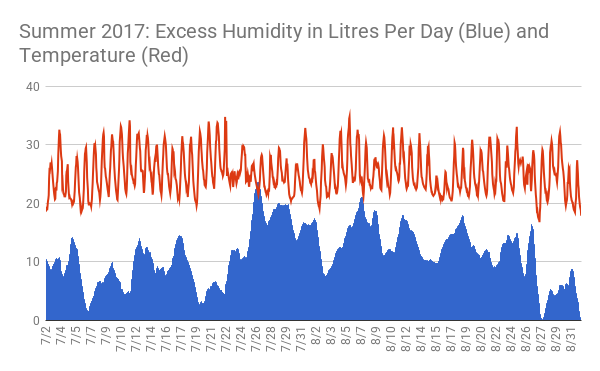
One very simple solution would be to switch off the ventilation system, or at least turn down the flow. This is a short term measure, because we do need fresh air in the house, but at night time and in the morning we open the windows and get plenty of fresh air in anyway. In fact the main demand for ventilation is to remove the moisture that we produce when we breath, wash and cook. If there are just a couple of people and a cat in the house, then we should be OK for a few hours. Turning down the ventilation would also be a good solution on cold winter nights when there is a risk of freezing in the drain from the ventilator.
One very simple solution would be to switch off the ventilation system, or at least turn down the flow. This is a short term measure, because we do need fresh air in the house, but at night time and in the morning we open the windows and get plenty of fresh air in anyway. In fact the main demand for ventilation is to remove the moisture that we produce when we breath, wash and cook. If there are just a couple of people and a cat in the house, then we should be OK for a few hours. Turning down the ventilation would also be a good solution on cold winter nights when there is a risk of freezing in the drain from the ventilator.
References
A great guide demystifying de-humidifiers here. I particularly appreciate them explaining the history of the difference between UK and US pints.
Formulae for calculating absolute humidity from relative humidity and temperature
Formulae for calculating absolute humidity from relative humidity and temperature
Workings:
Our house breathing in humid air:
Assume on a hot day the air coming in is humid and hotter than the inside air, so humidity will rise to saturation as it passes through the heat exchanger in the ventilation. (Actually this is a pessimistic assumption.)
28 degree air at 100% humidity holds 27 grammes water per cubic metre.
Assume 60% humidity inside. That means an extra 11 g/m3.
Air flow of 150 cubic metres per hour.
That's 1.6 kg of water per hour to get rid of.
Humans breathing out humid air:
In one hour we breathe in about 450 litres of air.
Assuming exhaled air is 100% humid at 36 degrees C; inhaled air is 60% at 28 degrees C.
1 cubic metre of exhaled air holds 42g of water vapour.
1 cubic metre of inhaled air holds 16g of water vapour.
We each contribute about 12 grammes of water per hour. Is that all?
28 degree air at 100% humidity holds 27 grammes water per cubic metre.
Assume 60% humidity inside. That means an extra 11 g/m3.
Air flow of 150 cubic metres per hour.
That's 1.6 kg of water per hour to get rid of.
Humans breathing out humid air:
In one hour we breathe in about 450 litres of air.
Assuming exhaled air is 100% humid at 36 degrees C; inhaled air is 60% at 28 degrees C.
1 cubic metre of exhaled air holds 42g of water vapour.
1 cubic metre of inhaled air holds 16g of water vapour.
We each contribute about 12 grammes of water per hour. Is that all?

Tuesday, 17 January 2017
Ventilation Leak

It came from the same place on the wall and seemed to be there all the time, although he could not confirm whether it was there while it was raining!
This seemed condensation-related, and evidently the cause was a problem with the seal on the exhaust vent meaning that instead of going outside, the exhaust air was going under the outer skin of the house.
 By November, it is usually colder outside than inside. The air is being cooled by the heat exchanger in the ventilation system as it leaves the house, and with at least a 10 degree temperature difference, and up to 50% relative humidity inside, this means the humidity of the exhaust air will usually reach 100% by the time it leaves. Since the ventilator does not have 100% efficiency, the exhaust air will always be a little warmer than the outside air, and have some moisture to deposit as soon as it hits something.
The something that was hit by the saturated and slightly warmer air seems to have been the inside of the siding, and the water found its way outside, where it dripped merrily away.

Friday, 30 September 2016
Kitchen extractor fans, and their fans
What about ventilation in the kitchen then?
The manufacturers of Best cooker hoods recommend you exchange something like ten times the volume of your kitchen per hour, which for a regular kitchen is between three and four hundred cubic metres per hour. Passive House recommends you need to ventilate the whole house around 35 cubic metres per person per hour. So these kitchen hoods need two or three times more ventilation than the whole house. Obviously this is a peak load, and the kitchen is not going to be ventilated the whole time.
Japanese cooker hoods typically have three settings: Strong, medium and weak. It may be my Japanese web-searching inability, but numbers don't seem to jump out when I try to find them. Instead there are rather a lot of sites asking why their extractor fans don't seem to be extracting very well.
This site of notes about making your own home (in Japanese) provides a lot of data about different fuels, and some calculations giving a figure of 1,166 cubic metres per hour (assuming three gas rings), or 551 if there are only two rings. Other sites and some of Mitsubishi's extractor fans go into the thousands.
There are probably differences in peak cooking intensity between Japan and the UK. The former has a culinary history based on wood as a fuel, which gives a strong high heat, ideal for steaming and stir frying. The latter, on the other hand, used peat or coal, which give a lower, longer heat more suited to baking or roasting. Hence the Japanese language has one work—yaku—which can translate into English bake, roast or grill, while there are various different Japanese words for fry, whether itameru (stir fry) or ageru (deep fry). But I'm supposed to be writing about ventilation here, not deep culinary thermodynamics.
The choice in Japan is typically between extractor only fans and those that will bring air into the house at the same time as they are expelling air. The latter are often recommended for houses that are airtight. In our house we got an extractor only fan, with the reasoning that it would only have one hole in the wall rather than two, and therefore make the house less leaky since extractor fan ducts are major causes of reduced airtightness. I'm not sure whether we made the right choice; w hen we switch the kitchen fan on, the front door becomes difficult to open.
In other countries, at least for passive house, another choice is recirculating hoods that will send the air through a charcoal filter to remove the oil and kitchen crap before releasing the scrubbed air back into the kitchen. The heat will then stay in the thermal envelope, and the air will sooner or later pass through the heat recovery ventilation.
Lloyd Alter on Mother Nature Network has interesting insights into the lack of clarity on the subject. And some very nice pictures of dream kitchens. He discusses how some people rail against recirculating kitchen ducts, while the people wanting low-energy buildings see them as essential. He points out that in Ireland you're allowed to connect a kitchen duct to a heat exchanger but in Canada it's illegal.
So what should you do? Recently I've been thinking about making a pizza oven in the garden. I know that doesn't entirely answer the question, but if you want to have a low energy house, do you want high-energy cooking inside? We then get into the question of whether low energy buildings should be enforcing low-energy lifestyles, or whether they should allow people do whatever they want while reducing the energy use.
By the way, if you were wondering why there are so many people complaining that their extractor fans don't work well, it's because they need cleaning.
Friday, 23 September 2016
Cross leakage and cross contamination
So the big issue with Energy Recovery Ventilation is that along with the moisture, other things are going to be transferred from the exhaust air to the incoming air, compromising its freshness.
This is also called cross leakage, or how much of the outgoing air will end up coming back in again. It even has an acronym: EATR (Exhaust Air Transfer Ratio).
Air xchange.com refers to US ASHRAE standards on cross leakage. Exhaust air is classified into four different groups: Class 1 air has low contamination, for example from office spaces, classrooms or corridors. Class 2 air has moderate contamination, for example from rest rooms, dining rooms, warehouses. Class 3 has significant contamination, for example kitchens, beauty salons, pet shops. Class 4 air has highly objectionable fumes or potentially dangerous particles, for example paint spray booths, laboratory fume exhaust or kitchen grease exhaust.
The US standard states that less than 10% cross contamination is acceptable for class 2 air. This seems like a lot, but in practice you will never get 0% contamination, even with a heat recovery system that is not trying to transfer moisture. Energy recovery systems can get as low as 1%.
This is also called cross leakage, or how much of the outgoing air will end up coming back in again. It even has an acronym: EATR (Exhaust Air Transfer Ratio).
Air xchange.com refers to US ASHRAE standards on cross leakage. Exhaust air is classified into four different groups: Class 1 air has low contamination, for example from office spaces, classrooms or corridors. Class 2 air has moderate contamination, for example from rest rooms, dining rooms, warehouses. Class 3 has significant contamination, for example kitchens, beauty salons, pet shops. Class 4 air has highly objectionable fumes or potentially dangerous particles, for example paint spray booths, laboratory fume exhaust or kitchen grease exhaust.
The US standard states that less than 10% cross contamination is acceptable for class 2 air. This seems like a lot, but in practice you will never get 0% contamination, even with a heat recovery system that is not trying to transfer moisture. Energy recovery systems can get as low as 1%.
Mitsubishi has a report on their Lossnay ventilation system with evidence from a test in 1999 that their membranes are fine enough to prevent bacteria from passing from exhaust to incoming air. They have more information about their systems in English here.
If the membranes are this good, then perhaps we should be using ERV after all, and they should be recommended for kitchens and bathrooms.
Another compounding factor with kitchens in Japan is that a lot of stir frying, deep frying and grilling seems to take place in Japanese kitchens, and there is usually an extractor fan with three or four times the ventilation needed for the whole house. More about kitchens later!
Green Building Advisor has a useful comparison of ERV and HRV, with a nice aside: "...assuming, of course, that the designer or installer hasn't made any blunders. (Sadly, this can be an optimistic and risky assumption.)"
Friday, 16 September 2016
Other kinds of ventilation system
There are two more kinds of heat recovery ventilation systems beyond the heat exchange and energy exchange cross flow or counterflow systems previously mentioned.

 More than one of these ventilators can be added in different parts of a building so that while one is blowing air in, another is sucking air out.
Also it has a remote control. I'm inclined to see this as a disadvantage, rather than an advantage, since we already have too many remote controls in our lives, and we really shouldn't need another one to breathe. Some people do like to have buttons to press though!
Air xchange.com has more technical considerations here about energy wheels.
One is the enthalpy wheel. Enthalpy is not completely sensible. It is a measure of the total energy of a system, including latent heat, so they could probably have just called this an energy wheel. It is also called a thermal wheel, or a heat wheel. The wheel rotates with the incoming air going through one half of it, and the outgoing air through the other half, parallel to the axis of the wheel. If it's hot inside and cold outside, the exhaust air will warm up the part of the wheel passing through that side, then when it passes through the other side, the wheel will warm up the incoming air.

These wheels have the advantages of energy recovery, potentially meaning more savings than a heat recovery system, and also reducing the risk of frost in the out-going air since the moisture is taken out of the air before it leaves the building. Also, the speed of the wheel can be adjusted to change the amount of energy recovery. This may be useful in seasons when you don't need to exchange much heat, or cooler nights in hot summers when you want to bypass the heat exchanger.
Enthalpy wheels also have the disadvantage of cross contamination, as some of the exhaust is going to get back in again. Enthalpy wheels may be suited to large buildings which need constant temperatures and humidities, with relatively low ventilation rates. For example, the Passive House-certified Hereford archive and records centre uses one.
An even simpler heat exchanger is the single room energy recovery vent, or ductless vent.
This looks a bit like a regular extractor fan, but it both inhales and exhales air, and passes it through a ceramic core that stores and releases heat. Typically these systems inhale air for something like 70 seconds, pause, then exhale air for 70 seconds.
 More than one of these ventilators can be added in different parts of a building so that while one is blowing air in, another is sucking air out.
This system has the advantage of not needing any ducts, and being very easy to retrofit, as Guy Marsden in Maine, USA explains. As it is recovering energy there is a potentially higher efficiency, better humidity control and lower risk of frost.
Also it has a remote control. I'm inclined to see this as a disadvantage, rather than an advantage, since we already have too many remote controls in our lives, and we really shouldn't need another one to breathe. Some people do like to have buttons to press though!
Another concern is that it's difficult to be sure that air blown out of the building is not going to be sucked straight back in again. Of course there is a potential problem with any ventilation system that badly positioned exhaust and fresh air outlets and inlets will just lead to a recirculation that makes irrelevant any worries of cross contamination within the system.
Also, with the inherent problem of cross contamination in the energy exchange system, it's difficult to see how this would work with toilets, kitchens and bathrooms, where you would really only want to remove air, but not supply it.
It's possible to imagine a configuration where the unit is placed next to an internal wall, and incoming air goes into one room, while outgoing air is expelled from another. I have no idea whether this is possible outside my imagination, but it may be worth trying!
Thanks to Devatech for the image of the wheel, which I shamelessly downloaded from your website!
And to Nihon Stiebel who supply a "Twin air fresh" ductless, decentralised ventilation system with energy recovery.
Air xchange.com has more technical considerations here about energy wheels.
Friday, 2 September 2016
Forgot to boil the water
In the jumble of pros and cons for ventilation systems recovering heat and moisture, the moisture advocates point out the extra energy in the water. This Polaris site (in Japanese) tells us the different heat contained in dry and humid air: apparently air at 20 degrees centigrade has 11.9 kCal of heat at 80% humidity, but only 9.2 kCal at 30%. He doesn't say how much air contains that much heat, perhaps a kilogram, or a cubic metre, or your living room? And he doesn't give a reference point for the heat, whether it is per degree, relative to zero degrees centigrade or the total heat relative to absolute zero. And how do we understand those numbers anyway? I usually only think about calories in food, and whether it's 11.9 or 9.2 it's still only about half a jelly baby.
Whatever the actual meaning of these numbers, humid air is going to hold more heat than dry air, since the extra water in the air is holding more heat.
But not only does the water in the air hold more heat, it also needs to have been vaporised. Most of us are familiar with water vaporisation, as it happens when we boil a kettle. Although 100 degrees is the boiling point of water, it doesn't all suddenly turn to steam when it reaches that temperature. It takes some extra heat to turn it from one phase to another. While it takes one calorie to raise one gramme of water by one degree, it takes over five hundred calories to turn a gramme of water into steam.
This is not just true of the water in a kettle, but of any water that is evaporating. For example the water in clothes hung out to dry inside, or water that has been poured on a plant, or water in our skin. Water evaporating from skin is our main mechanism for losing heat, and our sense of temperature depends largely on how much heat we are losing. This makes humid places feel hotter, because less moisture will evaporate into humid air than into dry air.
According to the ever-reliable Engineering Tool Box saturated air at 20 degrees centigrade has almost three times more energy than dry air relative to dry air at freezing, so the above figures would be more like 12.1 kCal per kilogram at 80% humidity and 7.5 at 30%. That's 60% more heat.
The consequence for ventilation is that if you have a system that is exchanging heat but not moisture (HRV), then in the winter you're going to be losing a lot of energy in the airborne water vapour you expel as you bring in dry air. And in summer you're going to be bringing in a lot of heat to the house embodied in the humid air.
So an energy recovery system will lose less energy, and is probably a good idea if you have dry winters or humid summers.
Of course you're unlikely to be choosing between 30% and 80% humidity. In the summer you may have 80% humidity and want 30%, and in the winter you're likely to get 30% humidity, but probably wouldn't want as much as 80%.
Of course you're unlikely to be choosing between 30% and 80% humidity. In the summer you may have 80% humidity and want 30%, and in the winter you're likely to get 30% humidity, but probably wouldn't want as much as 80%.
However, as the Polaris site points out, energy recovery systems transfer moisture back into the house. They usually do this across a paper membrane. Along with that moisture you can also get some bacteria and odours, which often makes people reluctant to use energy recovery ventilation in kitchens, bathrooms and toilets, putting simple extractor fans there instead. For example Mitsubishi suggests a dedicated extractor fan for the kitchen, and offers a system with additional drying, heating and direct ventilation options for the bathroom.
Since kitchens, bathrooms and toilets are the places you usually want to extract air from, while supplying fresh air to bedrooms and living spaces, you may end up only using heat recovery ventilation for a fraction of the house, and any efficiency gains are lost, perhaps along with improvements in interior humidity. Unless of course you can recover heat and moisture without letting anything else through.
Acknowledgment:
Special thanks to Ben Shearon for asking questions that lead me to investigate this topic.
Special thanks to Ben Shearon for asking questions that lead me to investigate this topic.
Note from Wikipedia: In SI units, cs = 1.005 + 1.82H where 1.005 kJ/kg°C is the heat capacity of dry air, 1.82 kJ/kg°C the heat capacity of water vapor, and H is the specific humidity in kg water vapor per kg dry air in the mixture.
Friday, 26 August 2016
A breath of fresh air in a sea of thermodynamics
I remember a conversation between our architect and one of the potential contractors, and the question was what kind of heat recovery ventilation system we were using. I'd only just discovered that heat recovery ventilation was possible, and didn't dwell too much on this question. The answer was that we were using heat recovery ventilation rather than moisture recovery ventilation.
To recap:
- If you want a warm house, you need insulation.
- If you have insulation, the house should also be airtight.
- If it's airtight you need mechanical ventilation with heat recovery.
Insulation, airtightness and mechanical ventilation with heat recovery represent a holy trinity of low energy building that cannot be violated.
Without insulation, you're going to lose a lot of heat, and you're going to get cold spots on the thin external walls, which will lead to condensation. Cold, expensive to heat, and damp!
Without airtightness, you're going to get humid air passing through the insulation and at some point that will lead to condensation. It will probably happen in the worst possible place: where you can't see it, but your structure can.
Without ventilation, you'll eventually suffocate, but way before that the humidity is going to get so high that you'll get condensation even where there is airtight insulation.
Mechanical ventilation is best because any kind of natural ventilation will usually lead to too much or too little exchange of air, depending on how nature is feeling at a particular time.
If you're going to have mechanical ventilation, you should put in a heat exchanger and then you don't need to throw away all the heat in the air.
...
So five years later I'm still learning things about ventilation. I've written a bit about our problems with heat recovery ventilation, but I know even less about the other kind: energy recovery ventilation, or moisture recovery ventilation. These are abbreviated to HRV and ERV for any fans of the TLA (three-letter acronym).
In both systems the air leaving the house passes through a heat exchanger and there is a transfer of heat to the air coming into the house across a membrane. In fact it is an array of membranes and with a well-designed arrangement of cross flow and counter flow, you can recover over 90% of the heat in the air. The transfer of heat follows the third law of thermodynamics, from hot to cold, so this will keep the house warmer in the winter, and cooler in the summer.
The difference between the systems is in moisture. Heat recovery ventilation just transfers heat, while energy recovery ventilation also allows moisture to transfer. This will also move from higher to lower humidity, so will tend to keep the humidity out in the summer, and stop the house from getting too dry in the winter.
So which one should you get?
As usual there are different schools of thought:
A) A is definitely better than B
B) Only a bloody idiot would use A
C) There are good and bad points of both so in the end it doesn't make a lot of difference which one you choose
A) A is definitely better than B
B) Only a bloody idiot would use A
C) There are good and bad points of both so in the end it doesn't make a lot of difference which one you choose
It's probably more fashion than physics, and I'm going to be writing about fashion soon!
But until that link works, you can read about the different kinds of heat exchanger from Zehnder America.
Tuesday, 23 February 2016
Dripping Diary
26th January, 2016
Water started dripping from the ceiling in the pantry this morning.
When you have water dripping out of somewhere, it's a good idea to find where it is coming from and stop it from going in there.
The immediate suspect, like the last five times water has appeared in unwanted paces, was the ventilation system two floors above.
This is actually the second water incident in the last months, but the first one was quickly noticed from the sound of drips on the bathroom ceiling, so it never got to build up anywhere.
There was no dripping on the bathroom roof this time. That's because it was not the ventilation system leaking, even though that's where the water was ultimately coming from.
I quickly came to a second hypothesis. Half a metre of snow outside... temperatures below freezing for a few days... the drain from the ventilation system coming out of the wall about twenty centimetres above the ground... frozen pipe!
 |
| left: drain from ventilation system |
The first evidence to support this hypothesis was the water spilling gently over the the top of the drain beneath the ventilation unit, rather than actually going down it.
A bit of hosepipe with a loop usually goes from the ventilation system to the drain. I diverted it into a bowl to stop sending more water to the overflowing drain.
The next evidence was outside: a large icicle coming out of the drain.
A few buckets of hot water and kettles later the icicle was gone. The visible part of the icicle went fairly quickly and was soon followed by the rod of ice from within the pipe. It took a little longer to thaw the elbow. Immediate problem solved, it was time to address the cause.
The ventilation system is going to produce condensate when it's cold outside, unless we also make it cold inside, or drop the relative humidity below about 20%. It's often going to be below freezing when it's cold outside, and that's where the water is going to be dripping. So it seems inevitable that ice is going to form and, sooner or later, the outlet pipe will freeze. It will then fill up with water and start overflowing. The only mysteries are: why has this not happened before? and why did the contractors not prevent this from happening?
I suspect this probably has happened before, but it takes a while for the pipe to fill up with water before it overflows, then it takes a while for the water to drip down, around the bath that is one level below the ventilation system, then onto the ceiling of the pantry below the bath. Some of this water will be evaporating all the time, and it could be a couple of days before enough builds up to break through the plaster boards and start dripping onto the floor. By this time, the temperature outside has always gone high enough above freezing, or a few rays of pre-noon sunshine have reached the drain and thawed it.
I was wondering if there were any mitigating circumstances leading to this, and there are a couple of things that may have made a difference. I noticed when I was clearing away another icicle a couple of days later that I'd left a gardening stake directly underneath the drain, from which was growing a nice icy stalagmite. Perhaps such a stalagmite had helped to block the drain. I was in too much of a hurry to melt the ice before and didn't document the hydro-crystalline pathology very well.
The other thing that we had done the night before this incident was to put on the humidifiers. It gets a bit dry in the winter since we're constantly getting rid of our humid air, and replacing it with air that's already fairly dry, and is then being heated so that the relatively humidity will fall about four times. We don't have any permanent remedy for this, but when we remember, and when it gets below about 30 percent, we switch on some of our humidifiers, usually at night time. So we are adding moisture to the warm air that we are expelling from the house over a steep temperature drop, and increasing the amount of water that will end up in condensate.
According to my previous calculation, the amount of water that's going to drip on a cold night is up to around 450 ml per hour. One drop is 0.05 ml, so that would be about two and half drops per second. Not fast enough to represent constant flow, but perhaps slightly faster than the ideal drip rate for forming icicles, which seems to be around one or two grammes per minute according to the Icicle Atlas. The precise temperature and humidity of the air in the house will determine the dew point, which will likely be a few degrees above zero. The dew point is really the critical number since it will tell us when condensation starts.
It's 23 degrees C and 30% humidity right now, so the dew point is 4 degrees. (According to this dew point calculator.) So if the air outside goes below about 2 degrees, it's going to drop below the dew point within the ventilation system. If we had 100% efficient heat exchange, then it would be cooling the air all the way down to 2 degrees, and the air coming in would be heated all the way up to 23 degrees. It's more like 80% so we lose a couple of degrees. Some ventilation systems will recover only 60% of the heat, so they will be less likely to reach the dew point. This is only a problem that will happen in well-ventilated houses with highly efficient heat exchange ventilation systems, so I suppose that answers the question of why the contractors hadn't thought about this happening, and why we've had so many problems with this.
When I say we've had many problems, we haven't exactly been wading through water, just needed to use a small cloth to mop up a few drops from the floor every year or two. And hopefully the structure of the house has not been damaged by the moisture.
The other problem ventilation systems have to deal with is freezing condensate. If the air is being cooled below freezing, it may start snowing in there as vapour in the air is precipitated. This would block the ventilation and we would no longer be able to ventilate the house, so the ventilation system does something with pressure differences to stop that. I'm not really sure what it does, but the result will probably be that it never gets as low as zero in there, and in fact there may only be a very narrow window of outside temperatures when condensate is actually being produced.
(Apologies to anyone who was hoping for a story about cooking fat from the North of England.)
Note:
The other drain in the picture is from the air conditioner, which we have hardly every used. This has a de-humidifer on it, and it would take moisture out of the hot air if we were using it. There is no chance of it freezing though.
Wednesday, 2 December 2015
Lesson 7: Ventilation
The first attempt at teaching a course is always a much bigger lesson for the teacher than the students. As in warfare, the first victim of a lesson is often the battle plan.
Three times I've found that a single lesson has turned into two, and the course feels like it is being resized and re-dimensioned. I thought we were almost half way through the time, but only a quarter of the way through the plan, but checking back with the plan I now realise that the lesson I had prepared on insulation included thermal bridges, and the lesson on air and water included ventilation, which were four lessons on the original plan, and I'm more or less where I thought I would be.
The ventilation lesson began at the realisation that houses must be both insulated and airtight to have low energy loss. If an insulated building is not airtight, three things will happen: you will get condensation within the walls, you'll lose heat with the leaking air, and you'll get fresh air in the house. The last one doesn't sound so bad, and in fact you need fresh air in a building. I asked the class why, and how much we need.
The most obvious is to provide oxygen. Although the most obvious it is not the most serious. We need around one litre of air per second per person to avoid a build up of carbon dioxide. Relatively low levels of carbon dioxide can lead to lack of concentration.
You need about three litres per second to remove nitrous oxides given off while cooking, and 3.5 litres per second do remove unpleasant odours from the house. Then you need about 6.5 litres per second to be safe from the volatile organic compounds that are used in paints, varnishes, glues and other chemicals in building and its furniture. The biggest need for ventilation is to stop a build up of moisture, for which we need about seven litres per second per person. The air we exhale is close to 100% relative humidity, since we are mostly water, and close to body temperature, since we are warm-blooded, so we're putting out a lot of moisture.
This means a design ventilation of 8 litres per second, or 30 cubic metres per hour per person. Taking an average of 35 square metres per person this means about one complete air change every three hours, or 0.34 air changes per hour.
Air can be changed by opening windows, using air vents, using extractor fans or mechanical ventilation systems.
Natural ventilation, whether by windows or vents, is cheap and easy. It works either on pressure difference or temperature difference. Opening windows on the north and south of a building will create a through draft. Opening windows upstairs and downstairs causes air flow through the stack effect. This can be calculated, but not in my lesson!
Natural ventilation will usually provide too much or too little ventilation. There is also a risk that someone will get in and steal your telly if you leave the windows open. And it may not be a good idea if it's raining outside. Extractor fans are relatively cheap and will provide a more steady rate of ventilation. Mechanical ventilation systems are more expensive to install but will provide steady ventilation, and also allow heat recovery.
So how much heat will be lost by ventilation? Using a few assumption, on a winter's day when it's freezing outside and 20 degrees inside, we lose heat at a rate of almost 200 watts per person. At first this doesn't sound like so much.
We looked at heating degree days. For example, the graph below shows in blue how hot it was outside and how many degrees each hour we have to heat up the air by.

As far as heating energy is concerned, a temperature difference of one degree for ten hours is the same as a temperature difference of ten degrees for one hour.
You can add these up over the year, and for Matsumoto it's a total of 80,000 kelvin hours per year, or 80 kilo kelvin hours per year. Incidentally this is about the same as for Manchester. So you can work out that ventilation for a year is going to lose 768 kWh. This is about a month's electricity bill, so it looks like quite a lot.
Finally I explained mechanical ventilation with heat recovery (MVHR), which turns out to be a very cheap way to heat your house, as long as you have gone through the expense of making it airtight and well insulated.

Also in today's lesson I gave out some questionnaires, which the school hands out in the middle of the term. Everyone seemed happy with the course the way it is, except one person who wanted me to make the calculations easier! I'm doing my best.
Saturday, 19 April 2014
Water is not going to collect in the summer... or is it?
Back to the mystery of the dripping ventilation system, at first I was worried about the lack of a drainage channel for condensate from air coming into the house in the summer. We've had enough problems with the channel for water dripping from the air leaving the house in the winter.
If it's very hot and humid outside, as the air comes into the house and through the heat exchange element, it's going to drop in temperature, and as it does so the relative humidity of the air will go up and over saturation, then water will start dripping from the air.
For example, it could be thirty-five degrees outside, 80% humidity, and twenty-five degrees inside. As the air comes in from outside through the heat exchange elements, it's going to drop from 35 degrees to about 26 degrees. If the heat exchanger were 100% efficient it would drop to 25 degrees, but it's around 90% efficient. The dew point for air at 35 degrees, 80% humidity is 31 degrees. It's going to hit that temperature inside the heat exchanger, and water is going to start precipitating.
At first I thought this would be a problem, but I was assured that it would be fine since the water is going to head towards the chamber of the ventilation system where the temperature is the same as outside, and the extra heat will allow the air to absorb the moisture.

But then I realised that actually it is going to be a problem, because water is going to be accumulating there, and while it might be fine in a steady state if you add some water to hot air, this is not a steady state. Humid air is constantly coming in, and water is going to be added to that chamber and will not be able to leave, so sooner or later it is going to push the humidity up and over 100% and water will start dripping.
However, just looking at the temperature and humidity here in Matsumoto in July and August 2013, the outside dew point never went above the inside temperature, and the closest it got was still three and a half degrees lower. Over those two months, the highest the dew point reached was twenty-two and a half degrees, and the lowest the temperature got inside was twenty-one degrees, ten days earlier. So it's possible to imagine that we'd get a saturation problem, but in practice when the temperature goes up the relative humidity drops and we're safe. This part of Japan is acclaimed for having dry summers, so I'm sure the story would be different if you were closer to the Pacific coast, not surrounded by mountains which do a good job precipitating humidity from the air themselves.
References

(TD is the dew point, f is the relative humidity, T is the temperature.)
Monday, 10 March 2014
Writing a nice letter
It's taken over a month to write to the supplier of heat but not a lot of light.
This is a translation of the first letter I wrote:
==
Dear @?x@*,
Thank you for your visit to our house to look at the third incident of leaking water from the ventilation system you installed. A couple of weeks later I went into the room where it lives, and found an overflowing bucket, which made me realise that the problem had not been fixed. I was shocked to hear that you expected me to pay for you to come again, so I got the manual and looked at it myself, following the clear and straightforward instructions on removing the cover, taking out and cleaning the heat exchange unit. Instructions that would be difficult to miss, unless you did not look at them.
While doing this, I noticed that the water was not draining properly from the pan in the bottom of the machine, even when the drain was clean and water was flowing smoothly through that. Water was collecting at the front of the machine, allowing crap to build up, as you can see in the enclosed photograph. Excuse my use of an engineering term.
Using a spirit level showed that the whole system is not level, and in fact the way it has been installed, hanging from the wall, it was really never likely to be level in the first place.
I'm not sure whether this is a design fault of the system, a flaw in the manufacturer's installation instructions, or if there is any other way of passing the responsibility on to someone else, but there are a couple of ideas you could use.
If you, or other companies, continue installing heat exchange ventilation systems in Japan, it would be nice if you could take problems like this seriously and ensure installation and maintenance that will not lead to leaking. Somewhat counter-intuitively, heat exchangers with better efficiency have bigger temperature drops so more condensation will come out of them. If it does not have a well made path, this water will make a new one, likely through the part of the house where it will do the most damage.
At the moment I'm thinking of the best way to make the system level.
In the mean time, please don't worry about our health. We will clean this regularly to avoid an outbreak of legionnaires disease.
Yours...
==
Of course, I didn't send this. Actually I didn't really write most of that until now, but that's what I wanted to say. I know that at most it would have caused still more heat, and not achieved any of my goals, except for some short-term satisfaction.
Obviously my main priority is to get my system working properly, although I think to do that I'll probably have to learn how it works and do the maintenance myself.
Another very big priority is stopping this happening to other people. These kinds of systems are essential to highly efficient buildings, and if they cannot be installed correctly people will stop using them.
So here's the second letter:
====
Dear @?x@* san,
====
Dear @?x@* san,
Thank you for coming to look at our leaking ventilation system. Two weeks afterwards I realised that the system was still leaking, so I followed the manual to clean it, including the heat-exchange element. While doing this, I noticed that water was not draining properly from the bottom of the system because it was not level. You can see in the enclosed photo how dirt has built up at the front of the drainage area. Using a spirit level showed that the system itself is not horizontal.
If you have any suggestions as to how the system can be made level, please let me know.
I hope that you will be able to avoid this kind of problem in future installations of heat exchange ventilations systems.
Yours...
====
Stick to the facts. We need to stick to the facts.
Here's the final version of the letter:Dear @?x@* sama,
Sorry for the delay in contacting you.
Thank you for coming to look at the water leakage from our heat-exchange ventilation system on 17th January. Two weeks later I realised that the leaking had not stop, so I cleaned inside the system and the heat-exchange element, as described in the manual.
At this time, it became clear that the system was not level, and water was not effectively draining from the system. Water was collecting at the front of the draining pan, leading to a build up of dirt, as can be seen in the photo.
Upon measurement, the system was not level, and was out by about 5 mm in 100.
I'm now thinking of a way to make it level.
Yours,
======
The morning after sending this, a reply came back:I looked at the attached photos.
==
Sunday, 23 February 2014
DIY ventilation maintenance
A couple of weeks later I went into the machine room. I think that's the best name for the loft with the power conditioners and the ventilation heat exchanger. That's all that's in there so the only reason to go is for the monthly cleaning of the filters or if the batteries need changing for one of the temperature data loggers in there. And of course whenever there's a problem from leaking condensate.
I just learnt that word from the Stiebel manual, which I've been reading to find how to clean the heat exchanger. The manual says in one place that it must be cleaned every three years, but elsewhere that it should be cleaned every year. The suppliers of leaky ventilation systems mentioned a three-year maintenance, and wanted us to sign a contract with them, which we did not. The system has been leaking for about the third time, and two weeks ago they came to fix it, which they did not.
I'd left a bowl under the system where it had been catching drips. I knew there would probably be a bit more water to drip through as everything dried out. I didn't expect it to be overflowing two weeks later, and still coming out after I'd emptied the bowl. I called the builders once again to tell them that the problem hadn't been solved. It was still leaking, a little less than before so it wasn't urgent for somebody to come, and since it was a snowy Friday, the following week would be fine. I got a call back to say he was in the area anyway and would be there at 6pm. He also said that the ventilation experts had asked me to contact them directly, which I'd evidently forgotten, misheard or ignored. Then a few minutes later another call came to say they'd be charging us. I asked why they'd be charging us this time, when they were just finishing the job that they hadn't done properly last time. Then I told them there would be no need to come, and I'd be in touch if necessary.
The first thing I noticed as I was following the instructions to get the heat exchanger out was that he'd put the filter back in the wrong way round. This is probably not a big deal if it's a clean, new filter, but it had been filtering a few weeks of crap from the air coming in, and since he put it back the wrong way round, that crap was all going to go straight into the innards of the machine, which the filter was supposed to protect against. My confidence is not inspired if he didn't know which way the air was flowing, or couldn't read the arrow on the filter, pointing in the direction of airflow.
Maybe I'm being hypercritical. I shouldn't be so harsh on these people who are innocently going about their business of importing European technology to Japan without properly understanding how it works.
 Removing the bypass unit from the ventilation system revealed a large pool of water in the bottom, with a drain in the middle that was not letting anything through. A screw driver helped unblock this.
 Once it was draining through the drain, it became apparent that the system was not level. The housing of the ventilation and heat exchange is all expanded polystyrene. Underneath the diamond-shaped heat exchanger unit there is a small reservoir with a drain in the middle. If I'd been designing it, I would have made it slope towards one corner and put the drain there. A few millimetres of water were still settling towards the front, so it wasn't very effectively draining. You can see the effect this has had of leaving a dirty residue. I remembered their boss saying that it was a good idea to drain the bath every night since the Japanese custom of keeping and re-heating bath water is an invitation to legionnaires disease. I'm sure he'll be shocked to hear about the stagnant pool of water he has installed in my house.
I don't know whether their failed attempt at fixing our problem was a gambit to get us to subscribe to a maintenance contract, or a genuine failure to fix it, but either way I don't think we've even got to the stage of maintenance. We are still dealing with getting a suitable system that has been correctly installed.
It sounds like the manufacturers are also culpable. This system was designed in northern Europen, and I think works very well there. Apparently there have been a lot of problems in Japan with systems leaking in the summer. The diamond-shaped heat exchanger fits in the middle of the unit, with air coming from outside going from bottom right to top left, then the air being sucked out of the house going from top right to bottom left. There's a collector and a drain in the bottom left chamber for the air being expelled during the winter, when it will be precipitating moisture. There is no drain for air coming into the house in the summer. This is not likely to be a problem in summer in Europe, where it is not so hot and not so humid. When it is high in the thirties and close to 100% humidity in a Japanese summer, there is going to be some precipitation on the other side, and no drain for it to drip through. Since hotter air carries so much more water, this could result in a lot more condensate than in the winter.
 Another issue is that Japan just seems to have a lot more bugs, germs, particles and general small crap. The average temperature is significantly higher and presumably this just multiplies a lot of stuff.
But the real question is, is anyone really interested?
If they are, then there are immediate and long-term solutions.
Long term, the system should have more rigorous drainage, so that it will handle regular and irregular condensate, both from expelled air in the winter and incoming air in the humid summer. Parts should be easy to clean. Build-up of crap in the heat exchanger itself is inevitable, and it may be that a lower-cost disposable material would be cheaper, long-term.
Short term, we need to get our system level, so that there is no pool of stagnant water in there. Another possibility is to put a collecting pan in there, that would funnel water from the heat exchanger through the drain.
Even more short-term, and probably medium-term, I need to contact the suppliers, the manufacturers, or their agents in Japan, and try to get someone to take this seriously since heat exchange ventilation systems are crucial to low energy building, and it is bad news if they are being driven around by cowboys.
I just learnt that word from the Stiebel manual, which I've been reading to find how to clean the heat exchanger. The manual says in one place that it must be cleaned every three years, but elsewhere that it should be cleaned every year. The suppliers of leaky ventilation systems mentioned a three-year maintenance, and wanted us to sign a contract with them, which we did not. The system has been leaking for about the third time, and two weeks ago they came to fix it, which they did not.
I'd left a bowl under the system where it had been catching drips. I knew there would probably be a bit more water to drip through as everything dried out. I didn't expect it to be overflowing two weeks later, and still coming out after I'd emptied the bowl. I called the builders once again to tell them that the problem hadn't been solved. It was still leaking, a little less than before so it wasn't urgent for somebody to come, and since it was a snowy Friday, the following week would be fine. I got a call back to say he was in the area anyway and would be there at 6pm. He also said that the ventilation experts had asked me to contact them directly, which I'd evidently forgotten, misheard or ignored. Then a few minutes later another call came to say they'd be charging us. I asked why they'd be charging us this time, when they were just finishing the job that they hadn't done properly last time. Then I told them there would be no need to come, and I'd be in touch if necessary.
The first thing I noticed as I was following the instructions to get the heat exchanger out was that he'd put the filter back in the wrong way round. This is probably not a big deal if it's a clean, new filter, but it had been filtering a few weeks of crap from the air coming in, and since he put it back the wrong way round, that crap was all going to go straight into the innards of the machine, which the filter was supposed to protect against. My confidence is not inspired if he didn't know which way the air was flowing, or couldn't read the arrow on the filter, pointing in the direction of airflow.
Maybe I'm being hypercritical. I shouldn't be so harsh on these people who are innocently going about their business of importing European technology to Japan without properly understanding how it works.


I don't know whether their failed attempt at fixing our problem was a gambit to get us to subscribe to a maintenance contract, or a genuine failure to fix it, but either way I don't think we've even got to the stage of maintenance. We are still dealing with getting a suitable system that has been correctly installed.
It sounds like the manufacturers are also culpable. This system was designed in northern Europen, and I think works very well there. Apparently there have been a lot of problems in Japan with systems leaking in the summer. The diamond-shaped heat exchanger fits in the middle of the unit, with air coming from outside going from bottom right to top left, then the air being sucked out of the house going from top right to bottom left. There's a collector and a drain in the bottom left chamber for the air being expelled during the winter, when it will be precipitating moisture. There is no drain for air coming into the house in the summer. This is not likely to be a problem in summer in Europe, where it is not so hot and not so humid. When it is high in the thirties and close to 100% humidity in a Japanese summer, there is going to be some precipitation on the other side, and no drain for it to drip through. Since hotter air carries so much more water, this could result in a lot more condensate than in the winter.

But the real question is, is anyone really interested?
If they are, then there are immediate and long-term solutions.
Long term, the system should have more rigorous drainage, so that it will handle regular and irregular condensate, both from expelled air in the winter and incoming air in the humid summer. Parts should be easy to clean. Build-up of crap in the heat exchanger itself is inevitable, and it may be that a lower-cost disposable material would be cheaper, long-term.
Short term, we need to get our system level, so that there is no pool of stagnant water in there. Another possibility is to put a collecting pan in there, that would funnel water from the heat exchanger through the drain.
Even more short-term, and probably medium-term, I need to contact the suppliers, the manufacturers, or their agents in Japan, and try to get someone to take this seriously since heat exchange ventilation systems are crucial to low energy building, and it is bad news if they are being driven around by cowboys.
Saturday, 23 March 2013
Defrosting the ventilation system
Apparently a heating element is standard with the ventilation system when it is supplied in Germany.
Exhaust air below freezing within the ventilation system is bad news, since it's going to be increasingly humid as the temperature drops and this will form frost when it drops below freezing, and could block the passage of air. This is not going to happen on the incoming air, since the temperature is rising and relative humidity falling, but it will very likely happen on the outgoing air.
Our system avoids this by blowing out more air than it sucks in. This makes the heat exchanger less efficient, so the outgoing air temperature drops less. It also drops the pressure in the house as a whole, and cold air is sucked in at two or three weak points in the airtight membrane. These points are the extractor fan in the kitchen, the gap at the bottom corner of the second and third leaves of our concertina door, and the front door.
In terms of a thermal system, a pressure imbalance is not a bad approach, if it is not used for long periods.
It's better having the house slightly under-pressure in the winter than over-pressure. Firstly, sucking cold air in probably means less heat loss than blowing hot air out, although every time I think about this, my head starts hurting. The cold air coming into the house will make the temperature drop a little, but the heat loss can be calculated by the lower efficiency of the heat exchanger. Secondly, an over-pressure house could lead to humidity building up in the wall structure, as air flows out and condensation occurs somewhere on the falling temperature gradient.
The alternative is heating the air coming into the heat exchanger so that it is closer to freezing and so that the air going out will not drop below the frost-point.
In this case, the temperature in the house will not drop much, and the heat loss can more directly be measured as the energy going into the heating element. This is likely to be electrical, and electrical heating is expensive. The main advantage is that it would stop the genkan area just inside the front door from getting so cold.
Monday, 11 February 2013
Extractor fan hot water units
The more I think about it, the more sensible seems the idea of pumping heat out of extracted air into hot water tanks. Given a reasonably well sealed thermal envelope, the places you want to extract air from a house are kitchens, bathrooms and toilets. These are also places where hot water is used.
And if you don't have a well-sealed thermal envelope, then extracting air is not an issue.
If you extracted 50 cubic metres and dropped the temperature by 20 degrees, 1,300 kJ would be available. If you did this every hour, you'd get about one kWh every three hours, 8 kWh per day. According to Without Hot Air by David Kay, in Sustainability without the hot air, a bath takes about 5kWh and a shower 1.4 kWh. He estimates 12 kWh of hot water per day per person, although he seems to include cooking, refrigerating and freezing in his sums.
The problems, of course, are in economies of scale and system complexity.
In the summer, rather than cooling the air going out, you would want to cool the air coming in, but you probably wouldn't want to be drawing air into the house via the kitchen, bathroom and toilet!
Air conditioners are now pretty much standard fittings in Japanese houses and models are available that heat water as they cool the air, but these are not widespread, and in installation they work out more expensive than buying separate units for heating water and cooling air, and since the air conditioner is not on for most of the year, another means of water heating is necessary anyway.
Useful physical characteristics of air:
Air holds 1 kJ per kg per degree change in temperature.
In cubic metres, that's about 1.3 kJ per cubic metre kelvin.
Friday, 28 December 2012
Hot air about ventilation
There's something about mechanical ventilation systems that seems to go against the whole idea of an eco-house. The idea of using electricity the whole time to pump air in and out of a hermetically sealed box just seems downright un-environmental.
But of the options it's probably the best one available.
To survive comfortably and healthily, you need the house to be substantially higher or lower than outside temperature. That's assuming that human health and survival are compatible with ecology, but that's a different discussion.
So, unless you're sitting on or near a source of heat that is free, or very cheap both financially and environmentally, you're going to need insulation.
For insulation to work well, it should also be airtight. However well insulation works, you're going to lose heat if air can escape in and out.
And if you're in an airtight envelope, you need some kind of ventilation, unless you're in a few acres of thermal envelope with trees purifying the air, or you use oxygen tanks like they do in submarines.
Ventilation means air leaving as well as coming in, and the leaving air is going to contain a lot of heat. So unless you recover heat, you're going to have to produce or procure a lot more, and unless it is controlled by a fan, you are often going to be exchanging too much or too little.
Natural ventilation depends largely on external weather conditions, so if it's windy, more air will change, and if it's still, less air will change. Pressure fluctuations will also change the amount of air coming in and out, and this is likely to mean loosing too much heat or not having enough fresh air.
So this leaves two options. The simplest is probably the Passive House solution of a ventilation system with a heat exchanger. This pumps the appropriate amount of air in and out of the house and, in the winter, transfers most of the heat out of the expelled air into the incoming air to keep the house warm, and in the summer, transfers the heat from the incoming air into the expelled air to keep the house cool.
The other option, which I thought about before deciding on the Passive House approach, was to recover heat from the extract air using a heat pump, and make hot water with it. In this case, as long as the air was being extracted in suitable locations around the house, airtightness becomes less critical. In fact relatively thick, permeable walls would have a temperature gradient and may warm the air as it comes through them, although unless it was arranged carefully, most of the air would leak in through specific gaps.
This may be less efficient than the Passive House method, as the heat exchanger is passive, while the heat pump is active. It would also mean more heating in the winter, since the ventilation system is not going to contribute to the heating any more. More heating means more losses through the heating system. The heat pump would be working on air at a higher temperature—20 degrees above freezing rather than the -6 outside that it was struggling against last night—so would be more efficient.
Rather critically, there would only be a fixed amount of air leaving the house, and this may not contain enough heat to meet the needs on a cold winter day. At first sight, it would seem that there is not going to be enough heat in the expelled air, since you're going to have to heat the air coming in up to that temperature, but first of all there is solar gain, so the house is gaining heat. Secondly, if the hot water tank is over-sized, and you are storing heat a large thermal mass like our concrete slab, it would be possible to store heat for a few days. Thirdly, it's possible to get more heat out of the air, but the temperature will drop below outside temperature.
At the moment, the heat exchanger is getting heat out of night-time air well below freezing. I'm not sure how fast the fan is blowing the air over it and what kind of volumes we're talking about. The amount of heat in air depends on change in temperature but, unlike humidity, the actual temperature makes practically no difference, so if you change the temperature of some air from 30 to 29 degrees, it's going to release the same amount of heat as a similar volume dropping from minus 9 to minus 10 degrees. The difference is in the amount of energy you need to get that heat up to the temperature you want, which is going to be over 70 degrees to be sure to wipe out those legionellas.
Also, recovering heat to make hot water would need 24-hour energy use to run the heat pump since the house is being ventilated 24 hours, and so we would not be using cheap night time electricity, and the bills may be higher.
Another advantage is that you could perhaps turn the fan the other way in the summer, so you can cool the house while making hot water from incoming air.
This all makes sense in terms of design simplicity for the overall system, but in terms of economics would end up much more expensive than getting separate systems for hot water and for ventilation. Air conditioners are becoming standard in Japanese new-builds, and atmospheric heat pumps a popular way of producing hot water, but it's rare to find systems that combine these two, rather than throwing away the heat from the air conditioner.
But of the options it's probably the best one available.
To survive comfortably and healthily, you need the house to be substantially higher or lower than outside temperature. That's assuming that human health and survival are compatible with ecology, but that's a different discussion.
So, unless you're sitting on or near a source of heat that is free, or very cheap both financially and environmentally, you're going to need insulation.
For insulation to work well, it should also be airtight. However well insulation works, you're going to lose heat if air can escape in and out.
And if you're in an airtight envelope, you need some kind of ventilation, unless you're in a few acres of thermal envelope with trees purifying the air, or you use oxygen tanks like they do in submarines.
Ventilation means air leaving as well as coming in, and the leaving air is going to contain a lot of heat. So unless you recover heat, you're going to have to produce or procure a lot more, and unless it is controlled by a fan, you are often going to be exchanging too much or too little.
Natural ventilation depends largely on external weather conditions, so if it's windy, more air will change, and if it's still, less air will change. Pressure fluctuations will also change the amount of air coming in and out, and this is likely to mean loosing too much heat or not having enough fresh air.
So this leaves two options. The simplest is probably the Passive House solution of a ventilation system with a heat exchanger. This pumps the appropriate amount of air in and out of the house and, in the winter, transfers most of the heat out of the expelled air into the incoming air to keep the house warm, and in the summer, transfers the heat from the incoming air into the expelled air to keep the house cool.
The other option, which I thought about before deciding on the Passive House approach, was to recover heat from the extract air using a heat pump, and make hot water with it. In this case, as long as the air was being extracted in suitable locations around the house, airtightness becomes less critical. In fact relatively thick, permeable walls would have a temperature gradient and may warm the air as it comes through them, although unless it was arranged carefully, most of the air would leak in through specific gaps.
This may be less efficient than the Passive House method, as the heat exchanger is passive, while the heat pump is active. It would also mean more heating in the winter, since the ventilation system is not going to contribute to the heating any more. More heating means more losses through the heating system. The heat pump would be working on air at a higher temperature—20 degrees above freezing rather than the -6 outside that it was struggling against last night—so would be more efficient.
Rather critically, there would only be a fixed amount of air leaving the house, and this may not contain enough heat to meet the needs on a cold winter day. At first sight, it would seem that there is not going to be enough heat in the expelled air, since you're going to have to heat the air coming in up to that temperature, but first of all there is solar gain, so the house is gaining heat. Secondly, if the hot water tank is over-sized, and you are storing heat a large thermal mass like our concrete slab, it would be possible to store heat for a few days. Thirdly, it's possible to get more heat out of the air, but the temperature will drop below outside temperature.
At the moment, the heat exchanger is getting heat out of night-time air well below freezing. I'm not sure how fast the fan is blowing the air over it and what kind of volumes we're talking about. The amount of heat in air depends on change in temperature but, unlike humidity, the actual temperature makes practically no difference, so if you change the temperature of some air from 30 to 29 degrees, it's going to release the same amount of heat as a similar volume dropping from minus 9 to minus 10 degrees. The difference is in the amount of energy you need to get that heat up to the temperature you want, which is going to be over 70 degrees to be sure to wipe out those legionellas.
Also, recovering heat to make hot water would need 24-hour energy use to run the heat pump since the house is being ventilated 24 hours, and so we would not be using cheap night time electricity, and the bills may be higher.
Another advantage is that you could perhaps turn the fan the other way in the summer, so you can cool the house while making hot water from incoming air.
This all makes sense in terms of design simplicity for the overall system, but in terms of economics would end up much more expensive than getting separate systems for hot water and for ventilation. Air conditioners are becoming standard in Japanese new-builds, and atmospheric heat pumps a popular way of producing hot water, but it's rare to find systems that combine these two, rather than throwing away the heat from the air conditioner.
Sunday, 23 December 2012
The house sucks...
...air in when the extractor fan in the kitchen goes on. This makes the pressure drop, and there are two consequence. One is that the front door is difficult to open. It's not impossible to open, but can be quite hard work. The first time I tried to open the front door when the fan was on, I thought it was locked.
The other problem is cold air coming in through the bottom hinge of our big window. Already the floor seems to be a few degrees lower around it as cold air is leaking in, but when the extractor fan is on, you can feel a draft. I think the window could be fixed so there is no draft, but this problem perhaps seems worse because the rest of the house, including all the other windows, is so airtight, and the air has to come in somewhere.
I imagined that the ventilation system would be able to accommodate this somehow, so I've been looking at the controls again. The two pertinent settings, I think, are "Fixed pressure imbalance" and "Constant pressure off".
For the latter, the default setting is zero, "No". It can also be set to 1, which is presumably "yes". The manual explains, "This enables the determination whether the fans should run at constant flow rate at all times or whether, if a certain pressure drop has been exceeded, the fan changes to constant pressure."
I changed it from the factory default, zero, to one. Then I wasn't sure if that was correct. Presumably it was trying to balance the pressure before, but was not doing well enough. For a start the ventilation system is set to shift 160 cubic metres of air per hour, whereas the kitchen extractor fan can shift over 500. There's no way it can compete. At the medium setting, the kitchen extractor moves 380 cubic metres per hour, and at low it shifts 160. It also has a regular ventilation function which shifts 90, at a power usage of 18 watts. This may be useful in some seasons. Also, it will take a while before the "certain pressure drop", whatever that is, has been exceeded, so the ventilation system is not going to start compensating as soon as the fan goes on.
A few days later, with constant pressure off, the door is being sucked in, and is getting increasingly difficult to open. I guess what is happening is that the ventilation system is diligently pumping in and out equal quantities of air, but every time the kitchen fan goes on more is pumped out and the pressure is dropping. Previously this would have reached an equilibrium after the ventilation system realised the pressure was different. Now it does not care.
The other setting, "Fixed pressure imbalance" was at the default of zero, so I'm thinking that this should perhaps be set to some positive number, so the pressure inside is slightly higher than the pressure outside. This would mean that any leaking air was going outwards, so drafts would stop coming in. All of the windows open outwards, so increasing internal pressure would probably strengthen the seals. The two doors open outwards, so they may become more leaky. With an over-pressure house, when the extractor fan went on, for a while it would just be bringing the internal pressure down towards the external pressure. "Fixed pressure imbalance" can be set anywhere between -100 and +100, but I wasn't sure what the unit was. Further reading suggests that it is the difference in cubic metres per hour of the fans blowing in and out.
As a complete thermal system, less heat is probably wasted if the house is at a lower pressure to the outside, and cold air is leaking in rather than warm air leaking out. If the house is over-pressure and air is leaking out, it will be room-temperature air, whereas if it's under-pressure, the air leaving the house will have passed through the heat exchanger, and be at a lower temperature. But, this is going to make the heat exchanger less efficient. The heat exchanger can only exchange as much heat to one side as it takes from the other. If the air going in and out are at different speeds, they won't be able to exchange the same amount of heat. My head starts hurting when I try to work this out, although that may just be because of the low pressure.
The morning after fixing these settings, the front door was still sucking in, and I went to see what the controls said. You can call up all the settings on the machine, so I saw it was expelling air from the house at 19 degrees and drawing in fresh air at minus 5. I also noticed that the flow rates were very different. It was expelling air as per the setting of 159 cubic metres per hour, but only bringing in air at 77 cubic metres per hour.
This is a frost prevention technique. As the air leaving the house drops in temperature, it will reach saturation somewhere above freezing, then if it's cold outside it will hit the freezing point saturated, so it's going to start snowing in there, or icicles will start forming. This is a bigger problem with more efficient heat exchangers. The solution they use is to change the rates of flow going in and out, which makes the heat exchange less efficient and means that the air going out will not drop much below freezing. Now I understand how the frost prevention works, but I'm still not sure whether we're going to get back to atmospheric pressure!
Monday, 10 December 2012
Steamy breathing
We've now got three new humidifiers in the house, each with a performance of 300 ml/hour, so if they're all steaming away they can put out 900 ml/hour, which should be enough to keep us at 50% relative humidity when it's bone dry outside. It may now be possible to over-humidify the house, so I'm just going back to the question of how much humidity is added to the house by other means. I know we have some plants in the house, but since we're watering them every few days with a single wine bottle, and the house is losing that much water every hour, they are not making a massive contribution.
We can easily estimate how much humidity we breathe into the air. Our lungs are moist and at body temperature, so we can assume exhaled air is saturated and around 37 degrees C. After a little googling, and avoiding the contentious red herring of how many breaths we make a minute and the futility of trying to count your own breathing rate, I found this site on normal breathing.
Apparently 6 litres per minute for a 70kg adult. That's 360 litres per hour.
From this site on humidity and anaesthesia, just in case anyone is still conscious out there, they have figures for water content in mg/l at 20-degree room temperature and 37-degree body temperature: 18 and 44 mg respectively. These figures correspond with the g/kg figures I was talking about in my humidity blog.
If the air going in is at 20 degrees at 50% humidity, holding 9 mg of water per litre, it looks like a standard adult will add around 35 mg/l, a total of 12 grammes of water to the air per hour. Two adults and two children will add around 40 grammes. So this is something like 5% of the humidity we're loosing on a day when it's freezing outside and 20 degrees C inside.
Another reason for humidifying is that apparently it makes the ventilation system exchange heat more efficiently. Presumably humid air carries more heat, so the heat exchanger will work better. I'm not sure how big an effect this is going to have. Stopping to think about this for a couple of seconds, once the air has been cooled ten or fifteen degrees, it's going to be saturated anyway, so it's only going to make a difference for the warm part of the heat exchanger. Perhaps the actual condensation of the airborne moisture in the heat exchanger improves the transfer.
But then the bells of legionnaires disease start ringing again.
Sunday, 14 October 2012
Under Pressure
The door was sticking a little the other day. It felt a bit like it does when the extractor fan is on in the kitchen. Because the house is very airtight, when the extractor fan in the kitchen goes on, it's difficult to open the front door. As is traditional in Japan, the front door opens outwards, so the decreased pressure sucks the door in and makes it feel like the door is locked. If all the windows are closed it's almost impossible to open.

The flow of the extractor fan is several times more than the ventilation system. There was an option to get an extractor fan which also lets air in to replace the air that is being extracted, but we decided against it as it was likely to reduce the airtightness. The doors and windows are all carefully sealed, and the vapour barrier and outside layer of tyvek have been carefully installed to get an airtightness around ten times better than the average house being built in Japan. The extractor fan is not designed to these exacting standards. In fact during the airtightness test the extractor fan was taped over, which apparently is standard practice, but seemed to me more like cheating. Regardless of the test result, throughout the life of the building an extractor that sucked air in as well would have two holes in the wall rather than one, and twice as many gaps.
Anyway, the extractor fan wasn't on, and it didn't seem quite like a pressure issue, so I thought it was another problem with our front door. We've had problems with the key on our front door, making me wonder whether it is a big crooked door to go with our big crooked window that we all got from what I worry is a big crooked German. Then I remembered the ventilation system.
I used to clean the filter every month, at the same time as my monthly collection of the temperature data from the thermometers around the house, and my monthly inputting and uploading of power generation and consumption data from the solar panel monitor. Since they put in the new ventilation system with the bypass, I haven't actually cleaned the filter.
When I went into the machine room, which was up in the thirties due to the power conditioners in there and the boiler below, and the insulation around the room keeping that heat from getting to the rest of the house, I saw "FIL" flashing on the ventilation unit. I had heard stories of people with ventilation systems very happy with them until they open them to clean the filters and are attacked by swarms of insects. No insects swarmed out, but there were plenty in there, mostly dead, and several fat spiders scurrying around. One moth flew out. The vacuum cleaner took care of them all.
The filter for air coming from outside had evidently become rather clogged, leading to less air being pumped into the house than being pumped out of it and, in spite of a few windows being open most of the time, lower pressure inside than outside. This was enough to suck the front door in and make it harder to open. It took a few hours for the pressure to balance, but the front door now opens normally.
The filter for air coming out of the house, there to protect the other side of the heat exchanger, had grey dust growing from it like small drifts of snow.
Once a month seems to be the right frequency for cleaning the filter, especially in the summer!
Sunday, 16 September 2012
A certified ventilation system
A side benefit of the reinstalled ventilation system is that we now have a unit that has been certified by the Passive House institute. They replaced the Stiebel Eltron LZW 170 with an LZW 270 Plus. The "plus" means that it has a bypass function, which is the part we wanted to help get rid of that summer heat. The 270 is more powerful than the 170 so it can ventilate more volume, although we already had enough with the smaller system. The other features are the same and it's difficult to beleive the efficiency has changed in any way.
As far as data entry is concerned, though, if you're entering manufacturer data for parts that have not been certified by PHI, you need to take off something like 12%. This is probably entirely justified, but in our case we can now increase the heat recovery efficiency from 78% to 83%. This doesn't sound a lot but brings our score down from 14.6 to 13.8 kWh/m2a.
Further investigation online shows that Stiebel give a heat recovery up to 90%, and they say that the Passiv Haus Institute has a figure of 86%. The database on the PHI website passiv.de, on the other hand, gives a figure of 83%. There is a mistake somewhere!
I suppose a lesson to learn, if the calculations are to be believed, is that ventilation and air tightness make a big difference, and having a well insulated house is not enough.
Subscribe to:
Posts (Atom)