Mark from Yamagata writes:
Dear Sir
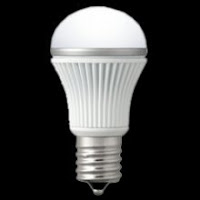
After reading the latest doses of your blog, I have a question for you. We have LED down lights in a number of rooms, and at a certain brightness they flicker, usually only intermittently. We have been told this is an irresolvable issue, a clash of LED vs dimming technology Comments?
LEDs are diodes. Diodes are semiconductors and this means that sometimes they conduct and sometimes they don't. A regular diode will conduct if you send electricity one way, but not if you send it the other. As their full name "light emitting diodes" suggest, LEDs emit light if you send current through them one way. I heard a company in Korea is developing diodes that will light up whichever way you send current through, which is a good idea in the world of AC power supply.
Anyway, there's a threshhold, usually 2 or 3 volts, at which they'll turn on. Since they are diodes and conventionally it only matters whether they pass electricity or not, on or off has traditionally been sufficient for conventional LED uses on displays. LEDs will produce more light with more current, but only above a voltage threshhold, and if there is too much current, the diode will start melting.
Dimmers traditionally work as variably resistors, so the more you turn them, the lower the resistance gets, and the less voltage there is across the dimmer and the more voltage there is going through the light. Conventional Edison-style incandescent lights also work like resistors, so the current is proportional to the voltage (as I'm sure you can remember from Ohm's law) and the amount of heat and light increase accordingly. This kind of old fashioned dimmer may work with light emitting diodes. Alternatively, it might work really badly as the LED will not turn on until the voltage is high enough, and may not dim the light; just turn it on or off.
The problem with resistors is that the current going through them is turning into heat all the time. More recent dimmers work by rapidly switching the electricity on and off. You can see more
here on how stuff works dot com. The AC comes in as a sine wave, and each time the sine wave crosses the zero volt line, then switch a little later. If you're only dimming the lights a little, they will switch on very quickly. If you're dimming a lot, they will switch on just before the voltage goes to zero again. This kind of dimmer should work well with an LED as it will switch it on for a shorter or longer part of the cycle.
LEDs use direct current (DC), not alternating current (AC) so within an LED "light bulb" there may a row of LEDs adding up to 100V, and a ring of diodes known as a
wheatstone bridge which sends the input AC voltage in the right direction so that one output is always positive and the other is always negative. Or they may have a step down transformer inside them. AC-DC power adaptors usually work by switching the AC to a much higher frequency, then converting it to DC. They may just be switching the voltage off when it's at the top of the sine wave, and far higher than is needed.
The flickering problem with the LEDs may be caused by a number of things. It could be that at a certain level, the voltage is close to the threshold for the LEDs to come on, so they are switching on some cycles and not switching on other cycles. Anything switching on and off 50 or 100 times a second is going to appear to be on all the time. Depending whether it's a US-based system or a UK based system, TVs change their pictures 25 or 30 times a second without appearing to flicker, but if you get down to about ten times a second, it's going to be obviously flickering. Apparently, this is known as the
flicker fusion threshold.
By the way, the difference between the 25 frames per second in the US and 30 frames per second in the UK depends, in turn, on whether the voltage is at 50 Hz or 60 Hz. The eastern half of Japan is 50 Hz while the western half is 60 Hz, apparently because in each half generators were introduced from the US and Europe respectively. This means that Japanese electrical appliance are generally made to work at either frequency, which has probably been an advantage in their international marketing. However, I digress.
Another possible cause of the problem is that there are two systems both chopping away at a sine wave, and there is some interference going on, resulting in a lower frequency flickering. If this is the case, and the LED lights have their own devices for chopping 100V AC into lower voltage DC, it may be that an old style variable resistor dimmer would work better.
I asked Mark for more details and found that the "certain brightness" at which they flicker was usually at about two points on the dimmer scale, say 1/3 and 2/3, but not exactly the same for each light, and the nature of the intermittent flickering was that they flicker for a few seconds, then stop, then flicker for a few seconds again, then stop, and so on.
As a solution I suggested he could just try avoiding the level at which they flicker when he dims them, apologising that this was both obvious and not very helpful as the level at which they flicker is clearly the level he wanted! He went on to say:
We have several types of dimmer down lights. The ones that are flickering have replaceable LED bulbs which are not built into the unit. The second type are unreplaceable (as opposed to irreplaceable--a good English lesson there--and built in. They apparently have 200,000 hours in them which will outlive me (though I think the max is really 40,000). These never flicker. At least not yet.
The life expectancy is usually 40,000 hours, but that's 40 years at 3 hours a day, which I think will probably outlive us anyway! In my opinion, irreplacable lights should be unreplaceable.
The ideal solution for dimming LEDs would seem to be a dimmer power supply that will output the correct voltage and current for a DC LED. This is available, even in Japan, for example here on Rakuten. But in the worst case, there is an LED light bulb screwed into a conventional fitting, connected to a dimmer switch, and the dimmer switch and the electronics inside the bulb are left to fight it out.
LEDs may be an irresolvable clash between electricians and new technology.
You can see more about how diodes work here on how stuff works dot com. The graphs above came from this website.