Showing posts with label eco-cute. Show all posts

Monday, 25 February 2013

Is it a fair COP?

Just looking at the spec for our eco cute in search of hard data on the temperature performance of the heat pump, it reveals very little. 

The spec is for two models, the CHP-H4619AT, recommended for "Region III" and the CHP-H4619ATK, recommended for Region I. The regions corresponds to the Next Generation Energy Efficiency standards, where Region I is Hokkaido, the coldest part of Japan, and Region III is Miyagi, Yamagata, Tochigi and Niigata in the lower North East of Japan, and the warmer parts of Nagano, which is central but mostly high in the mountains. 

Then it shows annual hot water efficiency of 3.1, which apparently is the ratio of the heat coming out in hot water to the electricity going in. So for a kWh of electricity, you get 3.1 kWh of heat. The note next to this says it is the situation using low energy mode, under certain conditions referred to in another note. The other note says that this is the average performance between Tokyo and Osaka, which are neither in Region I nor III but in Region IV.

Further down the spec, the mid-range rating for the heat pump COP is given as 4.5, which has no notes attached, but there are several notes to the numbers around it, which show the mid-range output heat and mid-range power consumption. "Mid-range" means an ambient temperature of 16 degrees (12 degrees wet bulb) and mains water temperature of 17 degrees with an output water temperature of 65 degrees. The electric power consumption is 1.33 kW and the hot water output is 6 kW; a ratio of 4.51. It also gives a summer figure with ambient temperature 25 degrees (21 degrees wet bulb) and mains water temperature of 24 degrees. The power consumption is then 0.97 kW and hot water output is 4.5 kW; a slightly higher ratio of 4.63). For the winter it gives ambient temperature 7 degrees (wet bulb 6 degrees) and mains water temperature 9 degrees with hot water at 90 degrees. The electric power in the winter is then 1.99 kW producing 6 kW of hot water; a significantly lower ratio of 3.0.

Two things leap out of this data when you actually look at the small print. The mid-range performance is suspiciously close to the summer performance. The winter performance is much worse. Since hot water use is going to be less in the summer, and more in the winter when the heating is on, the performance at the middle of the actual range is going to be between what it calls the mid-range performance and the winter performance. Also, the ambient temperature for the winter performance is about 5 or 10 degrees warmer than the actual ambient temperature we get in the winter. That's in Region III, let alone in Hokkaido in Region I.

It does give another note that under cold conditions, the performance will be lower. 

So there you go. 

The COP is 4.5...
Or 3.1.

Or some other number...

Wednesday, 20 February 2013

Heat pumps from cold night air

The bath talks to us.

We press a button or set the timer, and a little later it tells us when the bath is ready. If the bath's empty it's easy. It knows how much water is in the tank, it knows how hot it is, and it knows how much needs to go into the bath. If the bath has some water in it, then it must decide how much water needs adding and how much to heat up the water. Either it can add water from the tank, which will be relatively hot, or it can send water from the bath through the tank, from which it will take heat, in accordance with the second law of thermodynamics. Adding hot water is a lot more effective than circulating the existing water since the exchange has inefficiencies and there are heat losses as the water goes through the pipes between bath and boiler, even though we insulated them and kept them as short as possible. This is where the problems start.

Sometimes, there is not really enough heat in the tank to effectively heat up the bath. The bath brain probably starts off by adding hot water to the bath, then thinks that it's still not hot enough, so it starts circulating the heat to get it warmer. What it doesn't realise is that the heat from the boiler isn't going to get to the bath, or the part of the tank where the pipes from the bath are circulating may not be as hot as the part with the thermometer in. Rather than heat going into the bath, it may start leaving the bath, and dissipating into the larger thermal system following the inevitable fate of entropy. Then the bath's brain thinks "sod it", and gives up, without saying anything.

The bath talks to us, but it doesn't know how to say sorry.

This lukewarm bath situation is most likely to happen after a very cold night, when the heat pump is so inefficient that the energy would have been better spent drilling for oil in the Japan Sea. Obviously, I could just switch the boiler to be on all the time, or to "o-makase" (trust me) mode and let it switch on when it's warmer in the day time, but I don't really trust it. 

I would like to change the heating system so that the atmospheric heat source for the boiler is not night-time air, but the air flowing under the solar panels in the daytime.


This is the situation on a couple of clear, cold days in winter, midnight at the beginning of 13th January to midnight at the end of 14th. The black line is the temperature outside. The air temperature drops around 9 below zero on the first night, then up to around 2 degrees in the heat of the next day's sun. Then it plummets to -14 the following night and up to about 2 degrees again the following day. This leaves pretty cold temperatures for the Eco Cute to squeeze heat out of, leading to great inefficiency. 

The blue line is the temperature of air flowing through the channel under the solar panels on the roof. At night it gets just as cold as outside temperature. In fact on the night of the 13th, it was over 2 degrees colder because of the effect of the roof radiating heat to the stratosphere on a cloudless night. In the daytime, it gets over 30 degrees. If we could use the air from the channels in the middle of the day, rather than the air outside in the middle of the night, the air temperature could be 40 or 50 degrees higher. At this higher temperature, the heat pump would be much more efficient. 


The coldest nights and the warmest days are when it is clear, and of course it's not sunny every day. For example, this is the temperature on the panels the day it snowed. You can see the 14th and 15th January here, and how the temperature below the panels is just above freezing. In this case we have nothing to lose. The following day, with some snow still left on the roof, the temperature still got up above 10 degrees in the day time. You can see the temperatures from 12th January to 17th February below, perhaps averaging 25 or 30 degrees under the panels in the hottest part of the day, compared to minus 3 or 4 degrees outside at night. 


The main use of hot water is probably the bath, which we usually run at night time, so another advantage of switching from night time heat pumping to daytime heat pumping would be that the hot water would have less time to cool down, so we would need to use less of it. In terms of economics, this would mean a switch from using bought night time electricity to using our own generated electricity. Since we're buying off-peak electricity at 9 yen, but selling our electricity at 48 yen, the system would have to be 5 times more efficient to be worth changing. However, we only have a 10 year contract for selling our electricity at 48 yen, and no idea what may happen after that. 


This graph may give us an idea of how much energy we would save. Heat pumps are rated by COP, coefficient of performance, rather than efficiency. This corresponds to the amount of heat coming out compared to the amount of energy put in. So if you used 1 kW of electricity and got 5 kW of heat, that would be a COP of 5. The COP is affected by the temperatures inside and outside, so if you're trying to heat up luke warm water with hot air, you're going to get a much higher COP than trying to make hot water very hot from cold air. I've seen that Eco Cutes have a COP of 3.8, but this is a meaningless figure, unless you know precisely what operating conditions that was under. In the real world, not the world of advertising and eco-posturing, the COP for a particular heat pump is on a curve, dependent on the temperature of condensation, which happens outside, and the temperature of evaporation, which happens inside. Many heat pump manufacturers do not publish COP charts. From the graph above I estimate that if the temperature outside is 20 degrees higher, the COP will double. 

(The COP graph was stolen from Science Direct's website, from a paper which I did not pay $36 to read, by Forrest Meggers and Hansjurg Leibundgut of  ETH Zurich, Faculty of Architecture, Institute of Technology in Architecture, Building Systems Group, "The potential of wastewater heat and exergy: Decentralized high-temperature recovery with a heat pump". I hope they don't mind.)

Friday, 1 June 2012

More than just a pretty name

Having established that the Eco Cute is not particularly cute, and is only 'eco' if you're talking about economics, and macro-economics rather than anything on the micro level of the household or consumer, we have to admit that it is an intelligent device.

I somewhat maligned the eco cute in how much electricity it was using while we were away. Here's a graph of the daily usage. You can see that it's using more for the first week (average 6.6 kWh/day), then very little for several of the remaining days (average 3.9 kWh/day). The least the house used in a day was 2.1 kWh, ie running at a little under 100 watts. Looking at the hourly usage for that day, there was a flat graph whereas there are usually some bumps in the nighttime up to a few kWhours each hour while the Eco Cute is doing its thing. Taking this 2.1 kWh/day as the house base usage, for the first week the Eco Cute was using 4.5 kWh per day, then for the rest of the time 1.8 kWh per day. At 9 yen per kilowatt hour, this is hardly going to break the bank!
From the perspective of heat, this heat is going to be leaking into the house, so it gives us an idea of the extra heating bonus in the winter, and also the extra over-heating burden in the summer.
As far as working out what goes on inside the Eco Cute's brain, it appears that it calculates how much hot water is needed based on the usage over the past week, so for the first few days while we were away, it was labouring under the misconception that we were about to run baths of water. Doing this led to a tank full of hot water, leaking 4 and a half kWh of heat into the house each day. After a week, it realised that we weren't using any water, so it started producing more modest amounts, or in fact none for a couple of days.

Tuesday, 3 April 2012

Luke warm water

It was a beautiful sunny Sunday in February, so we went skiing. There's nothing nicer, after a hard day of skiing, than a nice hot bath. Usually I'd go to an onsen, a natural hot spring, and soak in abundant mineral rich waters, not worrying that they are probably heated with dirty oil because they lose so much heat to the outside air.

There was school the next day, and anyway, we have this fantastic new bath which can supply hot water, and it's only a short crawl to bed from there, rather than a drive. 

I just went with the kids, so I called as we were setting off asking the wife to put the bath on. We didn't get on that you could telephone.

When we got home, looking forward to a piping hot bath to sooth are muscles, the bath was not really all that hot. The first sign of something wrong was that the control panel didn't have the red light on to show that it was keeping the bath water warm. It's set to keep it warm for a couple of hours.

The previous day, we'd used too much hot water in the underfloor heating in the morning, and so there was no hot water in the evening and we didn't run the bath. That meant that it was starting from cold. 

I pressed the button again, and it announced that it was going to start running the bath, and the red light came on, and the little bath icon with lines floating up. A few minutes later it just stopped. No warning, no error message and no bleeping. It just gave up, put the lights out and the icon vanished. There were three bars when we'd got home, and these were starting to go down to two and then to one. 

When I checked the bath, it was not getting much hotter, but did seem to be getting fuller. 

The problem is the strategy for filling a bath. 

If the bath is empty, it's easy. It just needs to fill the bath with how ever many litres we've told it, at whatever temperature it's set for. Simple calculation based on the temperature of water coming out of the tank. 

Usually the bath is not empty though. As we get clean outside the tub, we don't need to change the bath water every day. I guess it measures the amount of water in the tub by the water pressure at the fancy jet thingy where it sends water in and out. If there is less than the required amount of water in the bath, it can get the water to the right temperature by adding hot water. Again this is a fairly simple calculation.  100 litres at 30 degress needs 50 litres at 60 degrees to make 150 litres at 40 degrees.

If the water in the tank is not hot enough to do this, then it can go to plan B, which is to circulate the water from the bath through the boiler, and re-heat the water in the bath. This is known as Oidaki.

The problem with this strategy is if the water in the boiler isn't hot enough, it will just take away heat from the boiler, and still leave the bath luke warm. Remember the second law of thermo dynamics. 

So I suspect what's happening is that the Eco cute tries to add hot water to the bath, realises that it can't get it hot enough with hot water, then tries Oidaki, and then gives up.

We just have to make sure that there is enough hot water, and in this case there wasn't for about four reasons.

First of all, the night before had been very cold, minus 11 in the morning, and not ideal conditions for an atmospheric heat pump. Exactly how unideal is an ongoing concern.

Second, we'd left the underfloor heating on for rather too long in the morning and run off a lot of the heat from the boiler. This left it in a situation of abundant water at low temperature.

Third, we had a full bath of cold water that had not been heated the previous day. Part of the reason why it  was full is that the washing machine is not working properly. It's supposed to be able to reuse the bath water in part of its cycle, but doesn't seem to be working. The bath water, controlled by a special tap and with a separate hose into the washing machine, keeps running into the washing machine when the tap is on, while the washing machine should actually be switching it on or off itself. That's another story though.

Fourth, and this may have been fairly critical, the temperature of the boiler was set to low. I'm not sure why, but I remember showing the wife how the temperature setting worked a couple of days ago, and maybe I didn't set it back again. If the boiler had been set to a higher temperature, in fact, everything would have probably been OK. It is now.
at least influencing 

Friday, 30 March 2012

Not so Eco and not so cute

The electricity bill for the month of March just came through, and the good news is that we only used 147 kWh. The bad news is that we were away for all of the covered period--23rd February to 25th March--so most of this energy was being used while we were out of the house. Maybe not a big deal in the grand scheme of things. This only added about 1800 yen to our electricity bill, which is little compared to the repayments on the loan, or on the amount they are paying us for our solar electricity generation, which was 45,000 yen for the same period. 

It seems a lot compared to last month when we were in and used 573 kWh. 25% in fact. 29 kWh were used in at-home time, and 117 night time. Only one kWh was used during day time, but this is not surprising as the panels will have been producing electricity for most of this time.

At-home time is 7 am to 9 am and 5 pm to 11 pm; 8 hours per day. For the 32 days, that's a power consumption of around 110 Watts. Night time is 11 pm to 7 am, also 8 hours, and you'd expect the same consumption, but it averaged 460 Watts. The only difference is the eco cute, programmed to come on at night.  Taking 110 Watts as the background consumption of the house, mainly the ventilation system and the fridge, which we left running, but also the circuitry and leds on display panels, and maybe some phantom consumption on the light bulb sensors, that means the eco cute used 88 kWh over the month. That's almost 3kWh per day, and we didn't use any hot water, and the underfloor heating was switched off. The energy it was using was just making up for the heat it was leaking into the house.

I'd set the tank to low temperature while we were away, but when we came back the display said it had one bath and 50 minutes of shower. I suppose this is less than one bath and 90 minutes of shower that it usually has, but this still seems to be a lot of heat. The exact meanings of the high, medium and low temperature settings are far from clear or explicit, and it seems like it's impossible to set them to actual temperatures, for example having the water in the tank at 50 degrees. Also, having thought that I could vary the amount of hot water in the boiler, it suddenly clicked that the setting of full tank, 50 litres or 100 litres is just for the amount of hot water it will add to the tank when you press the re-heat button. It doesn't make any difference to the amount of heat in there.

Without knowing the COP of the heat pump, it's difficult to know exactly how much heat this represents. I can maybe get some ideas by looking back over the temperature each night, and the electricity consumption data, and work out the relationship between the two, assuming that it's losing the same amount of heat each day from the constant set temperature of the tank (whatever that is) to the more or less constant temperature in the boiler room. Heat loss is proportional to temperature difference.

In a way this is the worst possible conditions for heat loss, as the tank was left full. But it was set to the lowest setting, and the boiler is inside. Imagine the usual situation where the boiler is outside, and it is left set to high. 


Wednesday, 29 February 2012

Eco con

During the explanation session, I asked the plumber about changing the temperature of the boiler, which he said was impossible. In fact, checking the manual and playing with the controls, I found that it was possible. There are three settings for boiler temperature: high, medium and low. Also, there are three settings for the amount of hot water in the boiler: a full tank (460 litres), 100 l or 50 l. 

The plumber didn't actually fit the boiler, so I don't completely blame him (although he shouldn't be telling people things are impossible when he just doesn't know how to do it), but the people who did fit the boiler also put in the underfloor heating, which they switched on to pump hot water through
the whole time, and did not set the boiler to the maximum temperature, so it was both using expensive day time electricity, and running out on us when it came to bath time. So they didn't know how it worked either!

I suspect there are many people, like my parents-in-law for example, who are producing way more hot water than they need and have not been told how to set their boilers properly. The Passive House lady considers this to be a serious national problem, causing massive excess energy use, and a lot of disgruntled customers.

The idea behind the Eco Cute is basically to use cheap night time electricity, from 24-hour nuclear and gas-fired power stations, and not really anything to do with ecology or saving people money. 

People with large households certainly get a good deal with their Eco Cutes, providing they don't run out of hot water. Meanwhile a lot of elderly couples, victimised by silver-tongued salesmen, find that their heating bills go up, on top of the investment of their savings into this new wonder, or worse still having been encouraged to take out a loan to pay for it. Over-dimensioned tanks with insufficient insulation incorrect settings.

The situation in Hokkaido is apparently that so many people are using Eco cutes that there is now a shortage of night time electricity.

Sunday, 26 February 2012

Not sure if it's Eco, or cute, but it can certainly do wonders with hot water

The fancy display panel on the wall next to the kitchen allows us to set the tap temperature anywhere between 35 and 60 degrees, and the clever control system will mix the water from the boiler, at a much higher temperature, with cold water to get us what we want.

The bath can be set to fill automatically to a range of heights and temperatures although only up to 48 degrees. So we can't use the bath for making soup.

The system is very intelligent. We tried to fill up the bath with the plug out the other day and very quickly the eco cute realised our mistake and switched off the water.

In our old house about once or twice every week we would either leave the water running so that it was spilling over the top, overheat the bath so that we needed to throw hot water away before we got in, or both.

Little bars on the display panel show us how much hot water is available from the tank. One bar for 50 litres at 50 degrees. 2 bars for 100 l, 3 bars for 150 l, 4 bars for 200 l and 5 bars for 300 l or more. With a 460 l tank, with water over 60 degrees, there will be a full five bars with just half the heat capacity of the tank. I'm having trouble finding in the manual exact temperatures for the high, medium and low temperatures the boiler can be set at, but in the spec at the end, it gives a range of 65 to 90 degrees.

As well as the bars, the display panel will show how much hot water there is, measured in number of baths and minutes of shower. I think it measures a bath as around 30 minutes of shower. At full tank, I've seen it gives one bath and 95 minutes shower, so it doesn't count in multiple baths. That wouldn't make sense in a communal bathing culture, as you can only have one bath.

There's a display panel in the bathroom, but this just shows how many minutes of shower are left. I suppose if you're in the bath, you won't be interested in how many baths there are, as you already have one, and if you're having a shower, you won't want to have a bath. I keep meaning to compare the number of minutes shower on the bathroom panel with the number of baths and minuts shower on the panel down stairs to get a more precise relationship between baths and minutes shower, but haven't managed yet. Anyway it wouldn't be that precise because the number of minutes shower is only to nearest five.

Everything works really well, but it's very difficult to find exact data, for example how hot is the water in the tank? How much is there? How much hot water did we use each day? 

The machine knows a lot of this, and when the temperature is set to "medium", it is looking at how much water we've been using, and heating the water appropriately. Maybe it's just me, but I'd like to know that information too!


Thursday, 23 February 2012

Getting into hot water

The heating system was fixed a couple of weeks after we moved in, and we have a panel on the wall under the stairs to adjust it. For all that we're trying to build a house that doesn't need a heating system in a country where houses traditionally don't have them, we seem to have done just that.

I think this is the first house in Japan I've lived in that has plumbed hot water and it's certainly the first house with any kind of central heating system. It's very European in the sense that it effectively has a boiler with a supply of hot water for washing and also for heating. For a day or two our boiler was running out of hot water, but this was because the heat was all being sent under through the pipes under the floor.

Hot water running out is something that anyone who has lived in a boiler culture will be aware of. My wife has never forgotten getting in trouble for using all the hot water when we were staying in a bed and breakfast before my brother's wedding. 

The concept of hot water running out is perhaps alien to Japan. Japanese has a separate word for hot water "o-yu" rather than "mizu", which it is tempting to argue is due to the abundant natural availability of hot water in the country. In many places it simply flows out of the ground. Hot spas spring up in the middle of cities, and clusters of hotels burst out around them in the countryside, in the mountains or by the sea.

Although this is the first house I've lived in with plumbed hot water, every house I've lived in has had running hot water, and copious amounts of hot water available in the bath. The first house I lived in had no running water in the bathroom, but you could fill the bath with water, and then heat and reaheat that. You could heat the bath a little, then you'd get some hot water at the top which you could scoop out for a shower. When she was a kid, my wife used to have to build a wood fire under the bath at her house. So there was a very visible body of water there. 

All the kitchens where I've lived have had a gas geyser that will produce hot water into the sink on demand. Instant hot water that only runs out if the gas is not connected, or if the battery goes in the geyser and the sparks stop working. 

Meanwhile, at around the same time my wife was loading wood to fire her bath a quarter of a century ago in the mid 1980s, I remember on my first stay in Tokyo seeing somebody going to a pay phone and dialling in some numbers without saying anything. He was setting his bath to come on so that it would be ready when he got home. His bath was electronically controlled to supply and heat the water, and the controller was connected to his answer phone, which could take remote instructions.

Monday, 20 February 2012

A tank in the house

Although we put ours inside, we're surrounded by houses with external boilers. As well as conducting heat to the outdoors, they sometimes have long pipes, probably not lagged, taking a while to deliver hot water, and wasting a lot of heat getting the hot water where it needs to go. 

Likely as not, though, they'll be in the traditional position for the bath water heater, right outside the bathroom, which will have a washing machine right next to it so the main water pipes. Unless some wiseguy architect has told them they can put it anywhere they like because the hot water pipes only cost 150 yen per metre. They don't realise that's also what they'll cost in wasted hot water each month.

External boilers are the norm for most of Honshu, the main island, but from the North East and certainly in the northern island, Hokkaido, putting boilers inside is common practice as well as common sense. It should be both in Nagano, which is a particularly cold area of central Japan, a good five degrees colder than the big cities of Tokyo or Nagoya. It seems people here would sooner have a tank in their house than put a boiler inside. 

Electric pipe heaters are also a normal fixture here, winding around outside water pipes, and switching on when the temperature approaches freezing, which can by as many as half the nights in a year up here. More running costs. More electrical devices. More profit for the electrical companies.

One of my concerns, having the boiler inside, is to keep the tank temperature as low as possible in the summer, when our hot water needs will be much less, and the heat leaking from the boiler is going to be making the house hotter.

Thursday, 14 July 2011

A future without fire... for Chubu Denryoku?

The local electricity supplier, Chubu Denryoku, sent a note to us about reducing our electricity consumption over the summer. They are especially worried about the period from July to September, and between 1pm and 4pm. Apparently around half of domestic electricity consumption is used on air conditioning. They suggest five things people can do:

1. Set the air conditioner to 28 degrees. People usually set it to 18, which is the lowest setting available.

2. Change the filter once or twice a month. This will make it run more efficiently. I suspect a lot of people never change the filter, instead waiting for the air conditioner to break, then they get a new one.

3. Use bamboo or rush mats on windows to keep the heat of the sun out.

4. Use a fan as well as, or instead of the air conditioner.

5. Don't leave stuff around the external unit of the air conditioner. 

They could also add shutting windows, which makes air conditioners more efficient as they just cool down the room rather then the broader environment.

More important still, they could mention INSULATION... 

While these requests for customers to reduce consumption of their product are admirable, they don't seem very interested in increasing the demand of energy. I went to ask them about connecting the panels on my house, and although they were not obstructive, they were certainly in no hurry to get them connected as soon as possible, for example at the beginning of July before this hot summer with its closed nuclear power stations and record cases of heat stroke, rather than in October after it has finished. I got the impression that they didn't really want to connect the solar panels at all.


On the wall outside their Matsumoto office, they have a hoarding advertising All Denka, or all-electric. At the top it says something about a future life without fire, promoting Eco-cute atmospheric heat pumps for hot water, IH cookers, and electric storage heaters. 

The picture is a mountain hut somewhere up in the mountains above Matsumoto. I struggle to find any connection between this and domestic electricity use. I'm quite sure it's heated with paraffin space heaters, or more likely abandoned in the winter when the roads are closed. In fact it looks like a perfect site for solar power, or wind. 


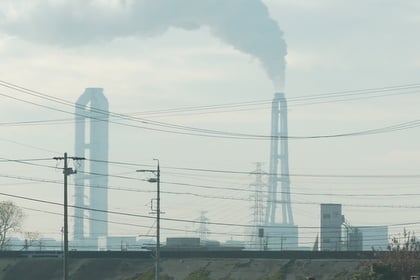
How about this picture of one of your eleven gas-fired power station? What was the expression... "no smoke without fire"...

I know Chubu Electric has 17 hydroelectric, and there is one nuclear power station that is having a rest at the moment. But according to this document from 2010, the gas-fired have a total rating of 23,900 megawatts, the hydro electric 5,300 MW and the nuclear 3,500 MW. They have a "new energy" 新エネルギー powerplant at Omaezaki, which produces 6 MW. That's 
Gas: 73%
Hydro electric: 17%
Nuclear: 11%
"new energy": 0.02%

I'm trying to work out exactly what the Omaezaki "new energy" plant is. Usually Google takes me to the Hamaoka nuclear power plant, which is, perhaps by some bizarre coincidence, in Omaezaki. The "new energy" hall is part of the visitors' centre at Hamaoka. There seems to be a 2.2 MW wind farm, turbines standing proud along the windswept beach. Perhaps used more as a kind of garnish next to Hamaoka, in much the same way that someone on a diet orders a salad and a diet coke, to go with the steak and chips. 

But it's easy to criticise. Putting into perspective this 6 MWatt "New Energy" plant, relating to 0.02% of their total capacity, my solar roof will have 9.12 KWatts, roughly 650 times smaller. This is the biggest rooftop array that the panel fitters had ever made. Most are around 4 or 5, less than one thousandth of the "New Energy" plant, which in turn is less than one five thousandth of Chubu electric's total capacity. 

A lot of their capacity is to meet peak demand. The gas and nuclear power stations are either on or off, so they need some way of storing extra energy when it is not being used, and supply it when it is needed, and hydro electric works well at this. 

They are also working on the hundred-year-old system of massive power production and long distance power transmission. This goes back to the  war of the currents between Edison and Telsa in the 1880s. Ultimately won by Telsa and Westinghouse. 

Other people in Japan are talking about smart grids, where electricity is generated on a smaller scale, and used or stored in a more dynamic way to reduce consumption.  If Chubu Electric doesn't start thinking about this, it's likely to see people switching off from the grid in a few years when solar panels have halved in price again, and batteries have become cheaper and more efficient. 

Monday, 13 June 2011

Less bare pipes... and some bare facts

We met the architect again and he provided some information on the pipe insulation. There was some information on standard polybutene pipe from the suppliers, showing how low their pipes' thermal conductivity was compared with stainless steel or copper pipes (k = 0.17 W/mK cf 16 or 330). This is rather like boasting how tasty your coffee is compared with muddy water.

He also brought a sample of 10mm thick insulating tube that goes around 13mm pipe, and some composite insulated pipe. The advantage of the former is that the inside pipe could be changed without needing to change the insulation. These insulators had a conductivity of 0.043, probably made of polyethylene. They're usually used here for external pipes, which have electric heating elements along the inner pipes to stop them freezing in the winter. The insulated pipes cost about 800 yen per metre. He also talked about some super-high insulated piping that cost 30,000 yen per metre. 

The idea of insulating hot water pipes still seems an alien concept, but to put it into perspective, running hot water in houses is a very new idea in Japan. In the usual mixture of very high and very low efficiency, until recently hot water has been created at or very near the source. Above the kitchen sink is a gas geezer, which produces hot water, up to near boiling. It has a pipe all of twenty centimetres long. The bath water is heated directly by a kerosene recirculating heater which is on the other side of the wall, again pipes very short. the longest pipes are perhaps from the gas heater to the shower, which is on the other external wall of the bathroom. Even then, the pipe may be a little over a metre in length.  In terms of layout, houses are designed by adding rooms onto each other, rather than rooms being filled into an overall structure. Bathrooms, and even kitchens, are not traditionally considered as part of the house; there's a sense in which they are separate rooms that have been added onto it, although kitchen-living-dining rooms have become quite common. In houses, Japanese lavatories always have a pair of slippers in them, and I believe this is because toilets are traditionally considered to be outside, so you need to put shoes on to go there. (I have to confess that most Japanese people think this idea is rather strange, but they have probably never stopped to consider the humble toilet slipper, any more than people in England have stopped to wonder why they put milk in tea.)

Until recently Japanese buildings have avoided the inherent inefficiency of central heating and hot water being generated in one place and distributed far and wide, but the recent propagation of the Eco cute atmospheric heat pump boilers means that hot water pipes are getting longer and longer, and awareness of the issue needs to increase if the Eco is going to reach the house-owner and environment rather than just staying as money in the bank for the manufacturers and electricity companies. At the moment heat loss in hot water pipes seems to be off the radar, languishing in the zone of apathy and ignorance.

Anyway, I did some calculations, and using the 13 mm polybutene pipes under the floor will mean a heat loss of 100 Watts per metre. In other words, whenever we are using hot water, it's like switching on a 100 Watt light bulb for each metre length of the pipe. To the kitchen, the pipe drops about three metres from the boiler upstairs, then meanders three metres under the floor, and climbs another metre to the sink. If we assume a very minimal ten minutes' hot water use per day, and ignore losses from what's left in the pipes each time it is turned on or off, then we will lose 42 kiloWatt hours per year. Similar calculations for 30 minutes' hot water per day going to the washing machine lead to 126 kWh per annum. 

Pipes with 10mm insulation will lose around 7.5 W/m. If we ignore the pipe space under the floor and save two metres on each length by sending the pipes across the ceiling and down the wall, and use higher insulated pipes, we get the losses from the kitchen down to 2 kWh/a and the washing machine to 5.4 kWh/a. Seems worth it. 

For these calculations, I'm assuming hot water at 45 degrees centigrade, and a temperature difference of 25 degrees to the 20-degree room temperature. I think 45-degree water should be hot enough. It's usually set much hotter, which just results in more waste. Thankfully, no hot water pipes have been installed for the basins by the lavatories, perhaps unthinkable in Europe, but another plus for Japan's eco-credentials. 

The architect had brought another sheet of paper with a list of insulated pipe materials and thicknesses, the thermal conductivity (熱伝導率 netsu-den-do-ritsu) in W/mK and what it called 熱貫流率 (netsu-kan-ryu-ritsu), the coefficient of overall heat transmission, which it gave in mK/W. Generally speaking, any given material has a thermal conductivity, which is some indication of how good it is at conducting. When it gets below 0.05 it's insulating fairly well, although there is no magic number at which something becomes an insulator and stops being a conductor. Wood is around 0.17 W/mK, and anyone in a log house will tell you that it's quite warm, if the walls are thick enough. Of course, even insulators conduct--just not very well. There are no perfect insulators (except a perfect vacuum) any more than there are perfect conductors.

Once a material is made into a wall, a pipe, a fur coat or some kind of structure, that combination then has a coefficient of heat transmission. For flat surfaces, this is usually given in W/m2K and called a U value or U factor. It shows how much heat will flow through the surface for each square metre, for each temperature difference of one degree. For pipes, this is given in W/mK, as we're not so interested in the area of the pipe, just its length. Rather confusingly, the units for thermal conductivity of materials, W/mK, are the same as those for pipes.

Whoever had produced the sheet of paper with the figures for pipe insulations had evidently not appreciated this, and for a start had got the units for coefficient of heat transmission upside down, mK/W. They had put a note at the bottom saying that it was a measure of how easily heat passed through the pipe which was correct. Whoever had made it had simply divided the thermal conductivity by the thickness of insulation, and come up with a number with scant regard for the units, dividing W/mK by metres, and getting mk/W. Obviously never heard of dimensional analysis.

Newton worked out that heat flow was proportional to surface area and temperature difference, and inversely proportional to thickness of material, and thermal conductivity is the heat flow per area, per temperature difference for a unit of thickness. To get to the heat transfer coefficient (U value or U factor) for a flat surface, you just have to divide the thermal conductivity by the thickness. (So if you had a wall of polyethylene one metre thick, it would conduct heat at 0.043 W/m2. The best natural insulators are around this level, so if you're aiming for 0.15 W/m2, your wall needs to be about 30 cm thick.)

For pipes, the picture is a bit more complicated as the surface area gets bigger the wider the pipe is. We have to use calculus, another of Mr. Newton's tricks, which should also be credited to Leibniz, and take the integral--the last recourse of the mathematical scoundrel. This gives us the equation:
Q = 2 pi k L (T1-T2) / ln(r2/r1)

Or U value for the pipe (in W/mK) = 2 pi k/ln(r2/r1)

Where:
k is the conductivity of the pipe material,
r2 is the external radius (half the diameter)
r1 is the internal radius
T1 is the internal temperature
T2 is the external temperature
ln is the natural logarithm. 
pi is π the ratio of the circumference to the diameter of a circle.

You can use Google as a calculator and put in something like (2 * pi * 0.17 /ln (0.0085/0.0065)) and it will understand and know what to do. Isn't technology wonderful!