Here is the third part of the Building Culture presentation, and the final video recording of the course.
Being the last video it should probably include a short summary of the main points, but it probably just ends rather abruptly, with more questions asked than answers, and many things left unsaid. A bit like this post.
Showing posts with label 湿度. Show all posts
Showing posts with label 湿度. Show all posts
Friday, 26 February 2021
Tuesday, 23 February 2021
Humidity and Traditional Buildings
When I talked about humidity the last time, I realised there was a lot more to say. It's not enough just to understand what humidity is, how temperature affects relative humidity, and how important it is to keep your walls airtight.
Keeping walls airtight is still very important, but we also need to understand how moisture moves through materials, and how important that is if moisture does get into your building materials, which is an undesirable, but unfortunately not unavoidable situation.
Keeping walls airtight is still very important, but we also need to understand how moisture moves through materials, and how important that is if moisture does get into your building materials, which is an undesirable, but unfortunately not unavoidable situation.
In this video I also look at traditional buildings, how they overcome humidity, and how traditional building culture can be influenced by events as well by the local climate and available building materials.

Tuesday, 10 November 2020
Air and Water: Condensation and Humidity
Whenever I talk about humidity I have a strong sense that I don't really know what I'm talking about. I think this is normal, because humidity is not at all intuitive. I know that my glasses will steam up when I come into a warm room from the cold. But what goes on within walls and buildings is complicated and strange. When predicting which way the moisture will go, I end up just assuming it will go where we don't want it!
In today's video I attempt to explain. In doing so I realised I need to say a lot more about diffusion, and probably do a whole new lesson on summer humidity. I can also talk about traditional approaches to protect buildings against condensation.
Also I suggested that high humidity could increase the risk of spreading viruses. In fact low humidity can increase the risk of spreading viruses.
Friday, 15 September 2017
Too Much Humidity
When we built the house I refused to add an air conditioner for two reasons. First because I didn't think we needed to spend money on cooling when the house was not going to be so hot, and secondly because I'm from Yorkshire where we don't use air conditioners. Actually that's probably just one reason.
 It may be global warming, acceptance of reality or weakness to luxury, but I think we need take active measures to remain comfortable in the peak summer heat. I need to take a closer look at passive house and high-temperature high-humidity in a different post.
The temperature is not a huge problem. It rarely goes over 28 degrees, and when it's 35 degrees outside, 28 degrees is a relatively pleasant temperature. The problem is when it is humid, and when it gets over 70% humidity it starts to feel really hot.
A de-humidfier would make the house more comfortable without making it cooler. In terms of thermal efficiency, de-humidification is a good idea since heat gain depends on temperature difference, so taking moisture out of the air makes it feel cooler without encouraging more heat to come in. On the other hand, making the house cooler means a bigger temperature difference, and more heat leaking in from outside.
Actually, we do have an air conditioner in one room, and that air conditioner does have a dehumidifier. But the de-humidify function just seems to work by cooling the air, and that room was not designed for the air to circulate through the rest of the house, so it just gets very cold in there when the dehumidifier is on.
Most dehumidifiers work by running air over a cooling element so that humidity condenses out of it. They differ depending on what happens to the heat that was taken away to cool the air. Either the heat can be put back into the air, or it can be taken out of the building. Our air conditioner does the latter, sending out cold, dry air. If you have a dehumidifer for a basement that gets damp in the winter, you want the former.
So do we want a dehumidifer that transfers the heat out of the house, or one that keeps it inside?
Should we try to dehumidify the air as it comes in through the ventilation system or should we get a standalone dehumdifier?
Would it just be cheaper and easier to get an air conditioner that can de-humidify?
Even if it was more expensive, would we be better off getting an air conditioner that can also cool and heat and do other fancy stuff? Maybe we could even get one that humidifies as well, since we need more moisture in the air in the winter.
Can I fit another air conditioner unit to the compressor that spends over 360 days of the year idle on my roof?
Or will it be cheaper to get another air conditioner with its own compressor?
How much moisture are we talking about?
The last question is easy.
If it's hot and humid outside, the ventilation system is going to be adding saturated air to the house. If it's 28 degrees, 60% humidity inside, with the ventilation system working at 150 cubic metres per hour, that is going to add 1.6 litres per hour. This is how much the dehumidifier needs to remove at peak load.
It may be global warming, acceptance of reality or weakness to luxury, but I think we need take active measures to remain comfortable in the peak summer heat. I need to take a closer look at passive house and high-temperature high-humidity in a different post.The temperature is not a huge problem. It rarely goes over 28 degrees, and when it's 35 degrees outside, 28 degrees is a relatively pleasant temperature. The problem is when it is humid, and when it gets over 70% humidity it starts to feel really hot.
A de-humidfier would make the house more comfortable without making it cooler. In terms of thermal efficiency, de-humidification is a good idea since heat gain depends on temperature difference, so taking moisture out of the air makes it feel cooler without encouraging more heat to come in. On the other hand, making the house cooler means a bigger temperature difference, and more heat leaking in from outside.
Actually, we do have an air conditioner in one room, and that air conditioner does have a dehumidifier. But the de-humidify function just seems to work by cooling the air, and that room was not designed for the air to circulate through the rest of the house, so it just gets very cold in there when the dehumidifier is on.
Most dehumidifiers work by running air over a cooling element so that humidity condenses out of it. They differ depending on what happens to the heat that was taken away to cool the air. Either the heat can be put back into the air, or it can be taken out of the building. Our air conditioner does the latter, sending out cold, dry air. If you have a dehumidifer for a basement that gets damp in the winter, you want the former.
So do we want a dehumidifer that transfers the heat out of the house, or one that keeps it inside?
Should we try to dehumidify the air as it comes in through the ventilation system or should we get a standalone dehumdifier?
Would it just be cheaper and easier to get an air conditioner that can de-humidify?
Even if it was more expensive, would we be better off getting an air conditioner that can also cool and heat and do other fancy stuff? Maybe we could even get one that humidifies as well, since we need more moisture in the air in the winter.
Can I fit another air conditioner unit to the compressor that spends over 360 days of the year idle on my roof?
Or will it be cheaper to get another air conditioner with its own compressor?
How much moisture are we talking about?
The last question is easy.
If it's hot and humid outside, the ventilation system is going to be adding saturated air to the house. If it's 28 degrees, 60% humidity inside, with the ventilation system working at 150 cubic metres per hour, that is going to add 1.6 litres per hour. This is how much the dehumidifier needs to remove at peak load.
A closer look at some actual data for temperature and humidity here in July and August shows that the outside air was never actually hot and humid enough to come in saturated. But with a more comfortable 50% humidity at 28 degrees, the peak dehumidification load is 24 litres per day.
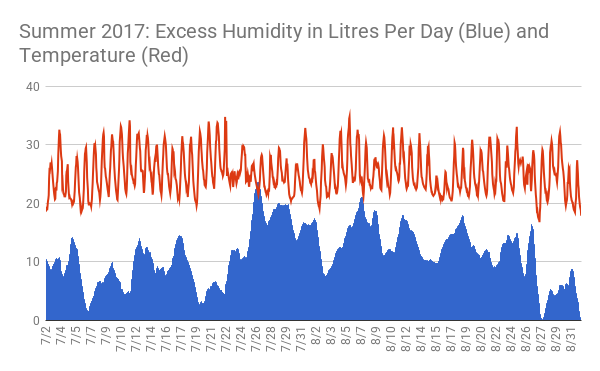
One very simple solution would be to switch off the ventilation system, or at least turn down the flow. This is a short term measure, because we do need fresh air in the house, but at night time and in the morning we open the windows and get plenty of fresh air in anyway. In fact the main demand for ventilation is to remove the moisture that we produce when we breath, wash and cook. If there are just a couple of people and a cat in the house, then we should be OK for a few hours. Turning down the ventilation would also be a good solution on cold winter nights when there is a risk of freezing in the drain from the ventilator.
One very simple solution would be to switch off the ventilation system, or at least turn down the flow. This is a short term measure, because we do need fresh air in the house, but at night time and in the morning we open the windows and get plenty of fresh air in anyway. In fact the main demand for ventilation is to remove the moisture that we produce when we breath, wash and cook. If there are just a couple of people and a cat in the house, then we should be OK for a few hours. Turning down the ventilation would also be a good solution on cold winter nights when there is a risk of freezing in the drain from the ventilator.
References
A great guide demystifying de-humidifiers here. I particularly appreciate them explaining the history of the difference between UK and US pints.
Formulae for calculating absolute humidity from relative humidity and temperature
Formulae for calculating absolute humidity from relative humidity and temperature
Workings:
Our house breathing in humid air:
Assume on a hot day the air coming in is humid and hotter than the inside air, so humidity will rise to saturation as it passes through the heat exchanger in the ventilation. (Actually this is a pessimistic assumption.)
28 degree air at 100% humidity holds 27 grammes water per cubic metre.
Assume 60% humidity inside. That means an extra 11 g/m3.
Air flow of 150 cubic metres per hour.
That's 1.6 kg of water per hour to get rid of.
Humans breathing out humid air:
In one hour we breathe in about 450 litres of air.
Assuming exhaled air is 100% humid at 36 degrees C; inhaled air is 60% at 28 degrees C.
1 cubic metre of exhaled air holds 42g of water vapour.
1 cubic metre of inhaled air holds 16g of water vapour.
We each contribute about 12 grammes of water per hour. Is that all?
28 degree air at 100% humidity holds 27 grammes water per cubic metre.
Assume 60% humidity inside. That means an extra 11 g/m3.
Air flow of 150 cubic metres per hour.
That's 1.6 kg of water per hour to get rid of.
Humans breathing out humid air:
In one hour we breathe in about 450 litres of air.
Assuming exhaled air is 100% humid at 36 degrees C; inhaled air is 60% at 28 degrees C.
1 cubic metre of exhaled air holds 42g of water vapour.
1 cubic metre of inhaled air holds 16g of water vapour.
We each contribute about 12 grammes of water per hour. Is that all?
Tuesday, 23 February 2016
Dripping Diary
26th January, 2016
Water started dripping from the ceiling in the pantry this morning.
When you have water dripping out of somewhere, it's a good idea to find where it is coming from and stop it from going in there.
The immediate suspect, like the last five times water has appeared in unwanted paces, was the ventilation system two floors above.
This is actually the second water incident in the last months, but the first one was quickly noticed from the sound of drips on the bathroom ceiling, so it never got to build up anywhere.
There was no dripping on the bathroom roof this time. That's because it was not the ventilation system leaking, even though that's where the water was ultimately coming from.
I quickly came to a second hypothesis. Half a metre of snow outside... temperatures below freezing for a few days... the drain from the ventilation system coming out of the wall about twenty centimetres above the ground... frozen pipe!
 |
| left: drain from ventilation system |
The first evidence to support this hypothesis was the water spilling gently over the the top of the drain beneath the ventilation unit, rather than actually going down it.
A bit of hosepipe with a loop usually goes from the ventilation system to the drain. I diverted it into a bowl to stop sending more water to the overflowing drain.
The next evidence was outside: a large icicle coming out of the drain.
A few buckets of hot water and kettles later the icicle was gone. The visible part of the icicle went fairly quickly and was soon followed by the rod of ice from within the pipe. It took a little longer to thaw the elbow. Immediate problem solved, it was time to address the cause.
The ventilation system is going to produce condensate when it's cold outside, unless we also make it cold inside, or drop the relative humidity below about 20%. It's often going to be below freezing when it's cold outside, and that's where the water is going to be dripping. So it seems inevitable that ice is going to form and, sooner or later, the outlet pipe will freeze. It will then fill up with water and start overflowing. The only mysteries are: why has this not happened before? and why did the contractors not prevent this from happening?
I suspect this probably has happened before, but it takes a while for the pipe to fill up with water before it overflows, then it takes a while for the water to drip down, around the bath that is one level below the ventilation system, then onto the ceiling of the pantry below the bath. Some of this water will be evaporating all the time, and it could be a couple of days before enough builds up to break through the plaster boards and start dripping onto the floor. By this time, the temperature outside has always gone high enough above freezing, or a few rays of pre-noon sunshine have reached the drain and thawed it.
I was wondering if there were any mitigating circumstances leading to this, and there are a couple of things that may have made a difference. I noticed when I was clearing away another icicle a couple of days later that I'd left a gardening stake directly underneath the drain, from which was growing a nice icy stalagmite. Perhaps such a stalagmite had helped to block the drain. I was in too much of a hurry to melt the ice before and didn't document the hydro-crystalline pathology very well.
The other thing that we had done the night before this incident was to put on the humidifiers. It gets a bit dry in the winter since we're constantly getting rid of our humid air, and replacing it with air that's already fairly dry, and is then being heated so that the relatively humidity will fall about four times. We don't have any permanent remedy for this, but when we remember, and when it gets below about 30 percent, we switch on some of our humidifiers, usually at night time. So we are adding moisture to the warm air that we are expelling from the house over a steep temperature drop, and increasing the amount of water that will end up in condensate.
According to my previous calculation, the amount of water that's going to drip on a cold night is up to around 450 ml per hour. One drop is 0.05 ml, so that would be about two and half drops per second. Not fast enough to represent constant flow, but perhaps slightly faster than the ideal drip rate for forming icicles, which seems to be around one or two grammes per minute according to the Icicle Atlas. The precise temperature and humidity of the air in the house will determine the dew point, which will likely be a few degrees above zero. The dew point is really the critical number since it will tell us when condensation starts.
It's 23 degrees C and 30% humidity right now, so the dew point is 4 degrees. (According to this dew point calculator.) So if the air outside goes below about 2 degrees, it's going to drop below the dew point within the ventilation system. If we had 100% efficient heat exchange, then it would be cooling the air all the way down to 2 degrees, and the air coming in would be heated all the way up to 23 degrees. It's more like 80% so we lose a couple of degrees. Some ventilation systems will recover only 60% of the heat, so they will be less likely to reach the dew point. This is only a problem that will happen in well-ventilated houses with highly efficient heat exchange ventilation systems, so I suppose that answers the question of why the contractors hadn't thought about this happening, and why we've had so many problems with this.
When I say we've had many problems, we haven't exactly been wading through water, just needed to use a small cloth to mop up a few drops from the floor every year or two. And hopefully the structure of the house has not been damaged by the moisture.
The other problem ventilation systems have to deal with is freezing condensate. If the air is being cooled below freezing, it may start snowing in there as vapour in the air is precipitated. This would block the ventilation and we would no longer be able to ventilate the house, so the ventilation system does something with pressure differences to stop that. I'm not really sure what it does, but the result will probably be that it never gets as low as zero in there, and in fact there may only be a very narrow window of outside temperatures when condensate is actually being produced.
(Apologies to anyone who was hoping for a story about cooking fat from the North of England.)
Note:
The other drain in the picture is from the air conditioner, which we have hardly every used. This has a de-humidifer on it, and it would take moisture out of the hot air if we were using it. There is no chance of it freezing though.
Tuesday, 17 November 2015
Lesson 6: A lesson in humidity
A week after my lesson in humility.
Once again I got about half way through my lesson plan by the time the bell went. This time it was a good thing as I reached a fairly neat cut-off point.
The title of the lesson was Air and Water, and after explaining humidity, I had planned to go on to talk about ventilation, but that will wait for another day. I hope nobody is holding their breath!
I started by asking why my glasses steam up when I come in from the cold, why mirrors mist up when you breathe on them, and what this has got to do with low energy buildings. The answer of course is humidity.
I next asked them to estimate how much air was in the room, and how much water was in the room. Their estimates for the amount of air in the room ranged from 150 to 600 cubic metres. I had a tape measure which allowed a more precise calculation, of around 190. Their estimates of the amount of water in the room were just as varied, although one group was also taking into account the human beings in the room, who are 70% water. I managed to steer us onto the water in the air, or more precisely water vapour.
Next I asked what you would do with water if you wanted to dissolve a lot of sugar in it. One of the students had brought to class a thermos flask with sugar water, which provided a nice link to this question.
In just the same was as you heat up water to dissolve more sugar in it, heating up air allows it to hold more water vapour. In fact the amount of water it holds doubles every ten degrees or so. Very roughly a kilogram of air at freezing will hold almost 4 grammes of water. At 10 degrees it will hold almost 8 grammes. At 20 degrees 15 grammes and at 30 degrees 28 grammes.
The trickier part to understand is relative humidity. This is the amount of water in the air as a percentage of the maximum moisture the air can hold. So for a given body of air, as the temperature goes up, the relative humidity will go down. As the temperature goes down, the relative humidity will go up.
 I tried to explain this by talking about the class, which had a total of nine students, of whom three were Japanese. So the class was around 30% Japanese. If three of the non-Japanese people left the class, there would still be three Japanese, but they would now be 50% of the class.
Back to the moisture in the air, if the temperature continued to go down, at some point it would become saturated and the water would start precipitating or condensing. That's called the dew point.
Next we considered what would happen if air were able to pass through insulation. In winter it's going to be something like 20 degrees inside and freezing outside. As the air passes through the insulation and the temperature drops, it's going to hit dew point and you'll get condensation forming in the wall.
This left me with my top two suggestions if you want condensation in your house: make it airtight with no insulation, or make it well insulated but not airtight. The moral of the story, in fact the moral of the course so far, a little insulation is a dangerous thing.
===
Temperature and humidity chart from sustainabilityworkshop.autodesk.com
Once again I got about half way through my lesson plan by the time the bell went. This time it was a good thing as I reached a fairly neat cut-off point.
The title of the lesson was Air and Water, and after explaining humidity, I had planned to go on to talk about ventilation, but that will wait for another day. I hope nobody is holding their breath!
I started by asking why my glasses steam up when I come in from the cold, why mirrors mist up when you breathe on them, and what this has got to do with low energy buildings. The answer of course is humidity.
I next asked them to estimate how much air was in the room, and how much water was in the room. Their estimates for the amount of air in the room ranged from 150 to 600 cubic metres. I had a tape measure which allowed a more precise calculation, of around 190. Their estimates of the amount of water in the room were just as varied, although one group was also taking into account the human beings in the room, who are 70% water. I managed to steer us onto the water in the air, or more precisely water vapour.
Next I asked what you would do with water if you wanted to dissolve a lot of sugar in it. One of the students had brought to class a thermos flask with sugar water, which provided a nice link to this question.
In just the same was as you heat up water to dissolve more sugar in it, heating up air allows it to hold more water vapour. In fact the amount of water it holds doubles every ten degrees or so. Very roughly a kilogram of air at freezing will hold almost 4 grammes of water. At 10 degrees it will hold almost 8 grammes. At 20 degrees 15 grammes and at 30 degrees 28 grammes.
The trickier part to understand is relative humidity. This is the amount of water in the air as a percentage of the maximum moisture the air can hold. So for a given body of air, as the temperature goes up, the relative humidity will go down. As the temperature goes down, the relative humidity will go up.
 I tried to explain this by talking about the class, which had a total of nine students, of whom three were Japanese. So the class was around 30% Japanese. If three of the non-Japanese people left the class, there would still be three Japanese, but they would now be 50% of the class.
Back to the moisture in the air, if the temperature continued to go down, at some point it would become saturated and the water would start precipitating or condensing. That's called the dew point.
Next we considered what would happen if air were able to pass through insulation. In winter it's going to be something like 20 degrees inside and freezing outside. As the air passes through the insulation and the temperature drops, it's going to hit dew point and you'll get condensation forming in the wall.
This left me with my top two suggestions if you want condensation in your house: make it airtight with no insulation, or make it well insulated but not airtight. The moral of the story, in fact the moral of the course so far, a little insulation is a dangerous thing.
===
Temperature and humidity chart from sustainabilityworkshop.autodesk.com
Saturday, 24 May 2014
Humidity makes it hotter ... or colder
When the scientific theory doesn't match your observation of reality, you know you've got one of them wrong. So it's been bothering me for a while that the theory suggests higher humidity makes it feel hotter while the evidence suggests the opposite at colder temperatures.
Finally I've realised the cause of this anomaly.
There are actually two effects of higher humidity on the body losing heat. One reduces the ability of the air to remove heat from the body, and the other increases it.
As we know, the body mainly loses heat through evaporation of the body's perspiration. The ability of this perspiration to evaporate is hindered by high humidity. Humid air just has less carrying capacity for those water droplets and will push up
The other effect is on the air's heat capacity. Water is a very effective carrier of heat, with a kilogramme of the stuff able to hold almost twice as much heat as a kilogramme of air. Adding water to air is going to increase this heat capacity. More heat capacity means a greater ability to take away heat.
Perhaps as it gets hotter, and the difference between body temperature and ambient temperature becomes smaller, the evaporation effect is larger, so humid air makes us feel hotter. Meanwhile, when it gets colder and the difference in temperature is larger, the higher heat capacity effect is larger.
Perhaps, but probably not.
Water certainly does have twice the heat capacity of air, but absolute humidity is measured in grammes of water moisture per kilogramme of air, so the increased heat capacity may only be one percent, comparing dry air with dripping wet air at 10 degrees centigrade. It's difficult to imagine this making the kind of two or three degree differences that humidity makes when it's hot.
Clothes are another matter though. The amount of water they can hold does not depend on temperature and absolute humidity, but on relative humidity and the related vapour pressure. Cotton can hold up to 15% of its weight in water, wool can hold up to 35%. Both of these textiles are hydrophilic and will try to reach an equilibrium with the atmosphere around them steadily releasing or absorbing moisture. That all takes energy, and any water content in the clothes needs to be kept warm.
At last this seems to make sense, although I'm not completely sure it's correct. I know the hiker's adage that cotton kills, but also I've heard that if you are stuck somewhere cold and damp, the best thing you can do is wrap yourself in a woollen blanket, since wool is exothermic.
Finally I've realised the cause of this anomaly.
There are actually two effects of higher humidity on the body losing heat. One reduces the ability of the air to remove heat from the body, and the other increases it.
As we know, the body mainly loses heat through evaporation of the body's perspiration. The ability of this perspiration to evaporate is hindered by high humidity. Humid air just has less carrying capacity for those water droplets and will push up
The other effect is on the air's heat capacity. Water is a very effective carrier of heat, with a kilogramme of the stuff able to hold almost twice as much heat as a kilogramme of air. Adding water to air is going to increase this heat capacity. More heat capacity means a greater ability to take away heat.
Perhaps as it gets hotter, and the difference between body temperature and ambient temperature becomes smaller, the evaporation effect is larger, so humid air makes us feel hotter. Meanwhile, when it gets colder and the difference in temperature is larger, the higher heat capacity effect is larger.
Perhaps, but probably not.
Water certainly does have twice the heat capacity of air, but absolute humidity is measured in grammes of water moisture per kilogramme of air, so the increased heat capacity may only be one percent, comparing dry air with dripping wet air at 10 degrees centigrade. It's difficult to imagine this making the kind of two or three degree differences that humidity makes when it's hot.
Clothes are another matter though. The amount of water they can hold does not depend on temperature and absolute humidity, but on relative humidity and the related vapour pressure. Cotton can hold up to 15% of its weight in water, wool can hold up to 35%. Both of these textiles are hydrophilic and will try to reach an equilibrium with the atmosphere around them steadily releasing or absorbing moisture. That all takes energy, and any water content in the clothes needs to be kept warm.
At last this seems to make sense, although I'm not completely sure it's correct. I know the hiker's adage that cotton kills, but also I've heard that if you are stuck somewhere cold and damp, the best thing you can do is wrap yourself in a woollen blanket, since wool is exothermic.
Notes and references
This article is only tangentially relevant, but has a good explanation of hydrophilic textiles seeking equilibrium with their environment: Iqbal, M., Sohail, M., Ahmed, A., Ahmed, K., Moiz, A. and Ahmed, K. (2012) Textile environmental conditioning: Effect of relative humidity variation on the tensile properties of different fabrics Journal of Analytical Sciences, Methods and Instrumentation 2(2), 92-97In fact there is much older work on moisture in textiles, for example, Albert C. Walker's Moisture in Textiles (1937, in Bell system technical journal, 16, pp 228-246). This goes into some detail on exactly where the moisture goes within cotton hairs.
And here is some propaganda from New Zealand wool industry: New Zealand Merino Company Limited (no date) Heat and moisture regulation.
You may want to compare this with the moisture content of wood. In textiles terms, of course, wood is just raw rayon.
A Q and A session on physics.stackexchange.com was helpful in debunking my first hypothesis, giving the formula cs = 1.005 + 1.82H, where 1.005 kJ/kg°C is the heat capacity of dry air, 1.82 kJ/kg°C the heat capacity of water vapour, and H the specific humidity in kg water vapour per kg dry air in the mixture.
Saturday, 19 April 2014
Water is not going to collect in the summer... or is it?
Back to the mystery of the dripping ventilation system, at first I was worried about the lack of a drainage channel for condensate from air coming into the house in the summer. We've had enough problems with the channel for water dripping from the air leaving the house in the winter.
If it's very hot and humid outside, as the air comes into the house and through the heat exchange element, it's going to drop in temperature, and as it does so the relative humidity of the air will go up and over saturation, then water will start dripping from the air.
For example, it could be thirty-five degrees outside, 80% humidity, and twenty-five degrees inside. As the air comes in from outside through the heat exchange elements, it's going to drop from 35 degrees to about 26 degrees. If the heat exchanger were 100% efficient it would drop to 25 degrees, but it's around 90% efficient. The dew point for air at 35 degrees, 80% humidity is 31 degrees. It's going to hit that temperature inside the heat exchanger, and water is going to start precipitating.
At first I thought this would be a problem, but I was assured that it would be fine since the water is going to head towards the chamber of the ventilation system where the temperature is the same as outside, and the extra heat will allow the air to absorb the moisture.

But then I realised that actually it is going to be a problem, because water is going to be accumulating there, and while it might be fine in a steady state if you add some water to hot air, this is not a steady state. Humid air is constantly coming in, and water is going to be added to that chamber and will not be able to leave, so sooner or later it is going to push the humidity up and over 100% and water will start dripping.
However, just looking at the temperature and humidity here in Matsumoto in July and August 2013, the outside dew point never went above the inside temperature, and the closest it got was still three and a half degrees lower. Over those two months, the highest the dew point reached was twenty-two and a half degrees, and the lowest the temperature got inside was twenty-one degrees, ten days earlier. So it's possible to imagine that we'd get a saturation problem, but in practice when the temperature goes up the relative humidity drops and we're safe. This part of Japan is acclaimed for having dry summers, so I'm sure the story would be different if you were closer to the Pacific coast, not surrounded by mountains which do a good job precipitating humidity from the air themselves.
References

(TD is the dew point, f is the relative humidity, T is the temperature.)
Friday, 28 February 2014
Humidity and temperature
There's a good table of the absolute humidity and temperature here at Transport Information Services, if anyone is intereste.
For a range of temperatures and relative humidities, at five-degree and ten-percent intervals, It shows the absolute humidity and dew point. The absolute humidity is grammes of water per cubic metre of air. The dew point is the temperature the air must drop to if water is going to start precipitating from it, or the temperature the air must not drop to if you don't want condensation.
The issue of humidity and temperature is in fact very complex, since you're looking at the properties of droplets of water that are behaving like a gas. More information in general is available here on wikipedia.
For a range of temperatures and relative humidities, at five-degree and ten-percent intervals, It shows the absolute humidity and dew point. The absolute humidity is grammes of water per cubic metre of air. The dew point is the temperature the air must drop to if water is going to start precipitating from it, or the temperature the air must not drop to if you don't want condensation.
The issue of humidity and temperature is in fact very complex, since you're looking at the properties of droplets of water that are behaving like a gas. More information in general is available here on wikipedia.
Also, you get forums like this one with lines like "We all know the ideal gas law, PV = nRT. But the number of moles, n, can be written as m/M where m is the mass of gas, and M is the molecular weight in g/mol. Then PV = (m/M)*RT."
If you do know that, then there are plenty of forums out there, and a great deal of physics. In the meantime, I'll stick to relative humidity doubling with every ten degree temperature drop, or use the table if I need more precision.
If you do know that, then there are plenty of forums out there, and a great deal of physics. In the meantime, I'll stick to relative humidity doubling with every ten degree temperature drop, or use the table if I need more precision.
Sunday, 23 February 2014
DIY ventilation maintenance
A couple of weeks later I went into the machine room. I think that's the best name for the loft with the power conditioners and the ventilation heat exchanger. That's all that's in there so the only reason to go is for the monthly cleaning of the filters or if the batteries need changing for one of the temperature data loggers in there. And of course whenever there's a problem from leaking condensate.
I just learnt that word from the Stiebel manual, which I've been reading to find how to clean the heat exchanger. The manual says in one place that it must be cleaned every three years, but elsewhere that it should be cleaned every year. The suppliers of leaky ventilation systems mentioned a three-year maintenance, and wanted us to sign a contract with them, which we did not. The system has been leaking for about the third time, and two weeks ago they came to fix it, which they did not.
I'd left a bowl under the system where it had been catching drips. I knew there would probably be a bit more water to drip through as everything dried out. I didn't expect it to be overflowing two weeks later, and still coming out after I'd emptied the bowl. I called the builders once again to tell them that the problem hadn't been solved. It was still leaking, a little less than before so it wasn't urgent for somebody to come, and since it was a snowy Friday, the following week would be fine. I got a call back to say he was in the area anyway and would be there at 6pm. He also said that the ventilation experts had asked me to contact them directly, which I'd evidently forgotten, misheard or ignored. Then a few minutes later another call came to say they'd be charging us. I asked why they'd be charging us this time, when they were just finishing the job that they hadn't done properly last time. Then I told them there would be no need to come, and I'd be in touch if necessary.
The first thing I noticed as I was following the instructions to get the heat exchanger out was that he'd put the filter back in the wrong way round. This is probably not a big deal if it's a clean, new filter, but it had been filtering a few weeks of crap from the air coming in, and since he put it back the wrong way round, that crap was all going to go straight into the innards of the machine, which the filter was supposed to protect against. My confidence is not inspired if he didn't know which way the air was flowing, or couldn't read the arrow on the filter, pointing in the direction of airflow.
Maybe I'm being hypercritical. I shouldn't be so harsh on these people who are innocently going about their business of importing European technology to Japan without properly understanding how it works.
 Removing the bypass unit from the ventilation system revealed a large pool of water in the bottom, with a drain in the middle that was not letting anything through. A screw driver helped unblock this.
 Once it was draining through the drain, it became apparent that the system was not level. The housing of the ventilation and heat exchange is all expanded polystyrene. Underneath the diamond-shaped heat exchanger unit there is a small reservoir with a drain in the middle. If I'd been designing it, I would have made it slope towards one corner and put the drain there. A few millimetres of water were still settling towards the front, so it wasn't very effectively draining. You can see the effect this has had of leaving a dirty residue. I remembered their boss saying that it was a good idea to drain the bath every night since the Japanese custom of keeping and re-heating bath water is an invitation to legionnaires disease. I'm sure he'll be shocked to hear about the stagnant pool of water he has installed in my house.
I don't know whether their failed attempt at fixing our problem was a gambit to get us to subscribe to a maintenance contract, or a genuine failure to fix it, but either way I don't think we've even got to the stage of maintenance. We are still dealing with getting a suitable system that has been correctly installed.
It sounds like the manufacturers are also culpable. This system was designed in northern Europen, and I think works very well there. Apparently there have been a lot of problems in Japan with systems leaking in the summer. The diamond-shaped heat exchanger fits in the middle of the unit, with air coming from outside going from bottom right to top left, then the air being sucked out of the house going from top right to bottom left. There's a collector and a drain in the bottom left chamber for the air being expelled during the winter, when it will be precipitating moisture. There is no drain for air coming into the house in the summer. This is not likely to be a problem in summer in Europe, where it is not so hot and not so humid. When it is high in the thirties and close to 100% humidity in a Japanese summer, there is going to be some precipitation on the other side, and no drain for it to drip through. Since hotter air carries so much more water, this could result in a lot more condensate than in the winter.
 Another issue is that Japan just seems to have a lot more bugs, germs, particles and general small crap. The average temperature is significantly higher and presumably this just multiplies a lot of stuff.
But the real question is, is anyone really interested?
If they are, then there are immediate and long-term solutions.
Long term, the system should have more rigorous drainage, so that it will handle regular and irregular condensate, both from expelled air in the winter and incoming air in the humid summer. Parts should be easy to clean. Build-up of crap in the heat exchanger itself is inevitable, and it may be that a lower-cost disposable material would be cheaper, long-term.
Short term, we need to get our system level, so that there is no pool of stagnant water in there. Another possibility is to put a collecting pan in there, that would funnel water from the heat exchanger through the drain.
Even more short-term, and probably medium-term, I need to contact the suppliers, the manufacturers, or their agents in Japan, and try to get someone to take this seriously since heat exchange ventilation systems are crucial to low energy building, and it is bad news if they are being driven around by cowboys.
I just learnt that word from the Stiebel manual, which I've been reading to find how to clean the heat exchanger. The manual says in one place that it must be cleaned every three years, but elsewhere that it should be cleaned every year. The suppliers of leaky ventilation systems mentioned a three-year maintenance, and wanted us to sign a contract with them, which we did not. The system has been leaking for about the third time, and two weeks ago they came to fix it, which they did not.
I'd left a bowl under the system where it had been catching drips. I knew there would probably be a bit more water to drip through as everything dried out. I didn't expect it to be overflowing two weeks later, and still coming out after I'd emptied the bowl. I called the builders once again to tell them that the problem hadn't been solved. It was still leaking, a little less than before so it wasn't urgent for somebody to come, and since it was a snowy Friday, the following week would be fine. I got a call back to say he was in the area anyway and would be there at 6pm. He also said that the ventilation experts had asked me to contact them directly, which I'd evidently forgotten, misheard or ignored. Then a few minutes later another call came to say they'd be charging us. I asked why they'd be charging us this time, when they were just finishing the job that they hadn't done properly last time. Then I told them there would be no need to come, and I'd be in touch if necessary.
The first thing I noticed as I was following the instructions to get the heat exchanger out was that he'd put the filter back in the wrong way round. This is probably not a big deal if it's a clean, new filter, but it had been filtering a few weeks of crap from the air coming in, and since he put it back the wrong way round, that crap was all going to go straight into the innards of the machine, which the filter was supposed to protect against. My confidence is not inspired if he didn't know which way the air was flowing, or couldn't read the arrow on the filter, pointing in the direction of airflow.
Maybe I'm being hypercritical. I shouldn't be so harsh on these people who are innocently going about their business of importing European technology to Japan without properly understanding how it works.


I don't know whether their failed attempt at fixing our problem was a gambit to get us to subscribe to a maintenance contract, or a genuine failure to fix it, but either way I don't think we've even got to the stage of maintenance. We are still dealing with getting a suitable system that has been correctly installed.
It sounds like the manufacturers are also culpable. This system was designed in northern Europen, and I think works very well there. Apparently there have been a lot of problems in Japan with systems leaking in the summer. The diamond-shaped heat exchanger fits in the middle of the unit, with air coming from outside going from bottom right to top left, then the air being sucked out of the house going from top right to bottom left. There's a collector and a drain in the bottom left chamber for the air being expelled during the winter, when it will be precipitating moisture. There is no drain for air coming into the house in the summer. This is not likely to be a problem in summer in Europe, where it is not so hot and not so humid. When it is high in the thirties and close to 100% humidity in a Japanese summer, there is going to be some precipitation on the other side, and no drain for it to drip through. Since hotter air carries so much more water, this could result in a lot more condensate than in the winter.

But the real question is, is anyone really interested?
If they are, then there are immediate and long-term solutions.
Long term, the system should have more rigorous drainage, so that it will handle regular and irregular condensate, both from expelled air in the winter and incoming air in the humid summer. Parts should be easy to clean. Build-up of crap in the heat exchanger itself is inevitable, and it may be that a lower-cost disposable material would be cheaper, long-term.
Short term, we need to get our system level, so that there is no pool of stagnant water in there. Another possibility is to put a collecting pan in there, that would funnel water from the heat exchanger through the drain.
Even more short-term, and probably medium-term, I need to contact the suppliers, the manufacturers, or their agents in Japan, and try to get someone to take this seriously since heat exchange ventilation systems are crucial to low energy building, and it is bad news if they are being driven around by cowboys.
Sunday, 2 February 2014
Maintenance, corrections and adjustments for humidity
I wrote that relative humidity doubles every ten degrees centigrade, but in fact that's not strictly true. It's more like 9.2 degrees. That's an approximation too, and in fact it's closer to doubling every 9.24 degrees at 20 degrees centigrade, and every 9.19 degrees at freezing, so it's not purely exponential. These are pretty trivial differences I know, and as a rule of thumb to understand the workings of humidity it's enough to know that it will approximately double every ten degrees.
It's also something of a rule that if you have water moving slowly and occasionally stopping, sooner or later there will be a build up of gunk. The inevitable impurities will accumulate, particles will appear and biology will happen.
We called the builders, and they called the ventilation experts, who have regularly appeared in these lines. A maintenance engineer turned up within a couple of hours and fixed it, putting an end to my empirical research into the amount of water held in air. The first thing he did was take the cover off while the ventilation system was still running, which at least my manual recommends against. I wasn't watching him the whole time as I didn't want to breathe down his neck, and the next time I looked he had switched it off. I always find it difficult to balance my interest in what workmen are doing with their need to get on with their job in peace.
After a while the engineer produced a small plug that had grown into the top of the hose pipe that drains the humidity. He recommended that we take off the hose and clean inside every couple of months to stop this.
I wish they'd told me that a couple of years ago!
Since there is going to be an irregular flow of water through there, and at least some particles from the air will reach it, there's bound to be some biological build up sooner or later. The water is going at around half a litre per hour, so it's not exactly the Niagara Falls in there, and anything that builds up on a surface that is not perfectly smooth will just keep building up. There will probably be times in the year when the system is completely dry, but I suspect for over half the year there will be some water coming out for some of the day. It's at room temperature, so the growing conditions are ideal for some bacteria and fungi.
When we moved in, they had offered us a maintenance contract, and I said I'd get back to them later. At the time I didn't want to sign a contract with them because I didn't really trust them. This engineer seemed to know what he was doing. He told me that the pipe coming out of the system needed a loop in it otherwise we'd hear the noise of water dripping out. I don't know whether he realised that I'd told his company this, since they hadn't put a loop in when they installed it, and it we had dripping and gurgling noises all night.
Also they had said that maintenance needed to be done every three years, but in fact in the manuals it recommends cleaning the filters every year.
His advice to clean the hose is probably good, but the build up was actually not in the hose, and probably not coming from the hose, which was downstream. The problem is coming from above.
So, I need to find someone else to maintain the system, learn how to do it myself, or go back and humbly ask them. There is a more local heating engineer who may be able to do it, and I'd like to ask him, but there are probably invisible walls that would be impossible for them to cross.
Saturday, 18 January 2014
How much water is in the air? A worked example
Here's a practical physics problem. I have a leaking ventilation system with a bowl catching the drips. How often do I have to empty the bowl?
Assume it's 20 degrees inside, with 40% relative humidity, and a little below freezing outside. Assumptions are approximate. All the best ones are. Save the precision for what you know.
A cubic metre of saturated air hold a little under 20 ml of water at 20 degrees C. A little under 5 ml at freezing. The ventilation system is set to shift 150 cubic metres per hour, so that's something like 450 ml of water per hour. The bowl holds 2.9 litres. It's going to fill up in about 6 hours.
Oh no, better go and empty it!
Wednesday, 15 January 2014
Dry air and dripping pipes
It is the dry season once again, and we have two problems. The first is keeping the house humid, and the second is avoiding pools of water on the floor.

A few days ago I was in the bath and heard a dripping noise. The drips were going in and out of sync, playing the kind of rhythm that will maintain the attention of someone relaxing in a nice warm tub. It sounded like there were two drips at different frequencies. Absorbing as this harmonic analysis was, my main concern was where the drips were coming from, and whether they were building up somewhere, planning a journey through wall and floor cavities to appear where they would do as much damage as possible.
Opposite to the UK, Japan has high humidity in the summer and low humidity in the winter. Rather than those damp winter days of drizzle and sleet, we often get clear days when the sun is out and the sky is blue, but the temperature struggles to go above freezing. When air is cold it holds less moisture, and since the relative humidity halves with every 10 degree temperature rise, by the time this air gets into our house the relative humidity is probably in the teens.
Most of the moisture in the air inside is then either residual moisture released from the walls and wooden floor, or moisture that we have added, either deliberately with our humidifier, or as a consequence of hanging up washing, cooking food, or breathing. I'm sure our house plants contribute something to the humidity too, if we remember to water them.

When this air leaves the house, it goes through the heat exchanger in the ventilation system, and with the drop in temperature of around 20 degrees, the relative humidity quadruples. If we've succeeded in getting the humidity over 30%, into the comfort zone for people and wooden buildings, that quadrupling will put the relative humidity over 100% and water will precipitate inside the heat exchanger, hopefully getting into the drain and finding its way out of the house.
This is where I thought the drip was coming from, but it sounded like it was coming from outside. I opened the window in the bathroom and it didn't sound like it was coming from outside after all. Next I went up to the room with the ventilation system, which is directly above the bathroom, and heard nothing and saw nothing there. At this point I gave up, hoping that it was something happening within the pipes.
A couple of days later I listened a bit more carefully and traced the drips to the ceiling of the bathroom. I got a step ladder, and opened the inspection door in the ceiling, which was quite exciting as I'd never done that before. Then I could see the drips coming from the pipe draining the ventilation system above. When I went upstairs there was a small pool of water under the drain where it comes out of the machine, and it looks like the fitting is leaking. There is a bowl under it now, and at the end of the long weekend, we'll call the builders and see if they can come and fix it, again.

Thursday, 17 October 2013
Humidity pump
Another way of looking at humidity is in the pressure of the water vapour suspended in the air. In a wall, there is a temperature gradient between the inside temperature and the outside temperature. In the steady state this is going to be a straight line. If the insulation is glass fibre, air and moisture can pass with some freedom. If hot air from inside is passing all the way outside, as the temperature drops the humidity will rise so at some point the humidity will likely reach 100% and you will get condensation. To stop this, you need vapour barriers that will stop the air inside the house flowing through the wall structure. Then, the air will stop flowing, and in theory at least, you'll get constant humidity throughout the wall, even though the temperature is dropping and there is much less absolute moisture content in the air close to the outside than there is close to the inside.
In the summer, the temperature outside is higher, so you have the opposite situation and the danger of water condensing on the way in, as the temperature drops. The humidity inside the house is higher, so the walls may get too humid at some point.
Wufi software simulates the performance of a wall structure over time, and you can see an example below, although this is not for our house!

Just like insulation slowing down the heat rather than stopping it from escaping, vapour barriers and other kinds of waterproofing do not stop water, they just slow it down. Anyone who has stayed in the rain for long enough in waterproof clothes knows this. It's fine for a while, but eventually the rain will get through. I remember my Dad discovering how waterproof his boots were after a very rainy walk around Haweswater in the English Lake District--water had got into them but it took for ever to get out again. Cheap waterproofs can also be sweat proof, so sooner or later you're going to be wet inside anyway.
Essentially our house has a couple of rain coats on. On the outside is Tyvek sheet is made by Dupont, who also make Goretex rainwear, which is designed to stop precipitation from getting in while allowing perspiration to get out. We need the same thing in a house, so that moisture does not build up within the wall structure, leading to rot. Tyvek stops drops of water from getting through, but will let water vapour pass, so the walls can stay dry.
We used Intello inside the wall structure, which allows very little moisture through in the winter, preventing condensation and rotting walls. In the summer, it opens up and lets moisture through, which allows the walls to dry out.
You can see an interesting effect below of humidity going up with temperature, instead of going down as it usually does. The first chart is the normal situation, where the relative humidity gets lower as the temperature goes up, since the absolute humidity is the same, but the air's capacity for water vapour increases. The lines at the top are humidity, the higher one outside the house, and the lower inside the house. The temperature lines are below.

The next chart shows the humidity and temperature within the wall, when the sun is beating down outside, making the temperature just inside the Tyvek high. This makes the humidity low, and as a result, humidity starts flowing outwards through the wall. We're measuring temperature and humidity in the middle of the wall, so at some point it should be possible to test how the wall performs in real conditions. After almost two years, the humidity seems to be staying in a safe range.

Thursday, 27 June 2013
Humidity makes it feel hotter. Or is it colder?
Something's been bothering me about humidity. When it's more humid it feels hotter, so a humid summer's day will feel a few degrees warmer than if it's dry. This is because we judge temperature by the rate at which our bodies lose heat, and since they lose heat by evaporation, they lose heat more slowly when there is more humidity.
So how come cold damp days feel much colder than cold dry days? Isn't the humidity going to make us lose heat more slowly and make us feel warmer at this temperature too? The answer is clearly no.
It probably has something to do with clothes. I guess what happens on a cold, damp day is that the cold damp air hits our clothes, which are going to be closer to ambient temperature on the outside and closer to body temperature on the inside. The clothes are going to be busy heating up all that air, and because it's humid, that's going to take more energy, so you're going to lose heat. Or something like that.
I'm not sure if that makes any sense, but perhaps higher humidity makes you feel warmer if you're naked.
Taking your clothes off when it's cold and humid may not necessarily be the answer. However, this was a habit of the indigenous peoples of Patagonia, where there are sub-arctic rain forests of high humidity and low temperature. Apparently when the Christians came along, they encouraged them to wear clothes. The result was mass outbreaks of pneumonia and decimation of the population. It's not clear to what extent this was due to the clothes or due to the germs of the Europeans, which were probably responsible for most of the 90% drop in population of the Americas upon the arrival of Columbus.
Neither am I any less confused about the relationship between humidity and apparent temperature when it's cold.
Friday, 7 June 2013
Condensation on the windows
People have asked about condensation on windows. I heard a story from someone who moved into their new house and complained to the architects about condensation on the windows. It seemed like quite a serious problem. The architect's solution was to wipe the window with a cloth.
So, do we get any condensation on our windows? Well, the answer is yes. But not on the inside and not in winter. We get it a few times a year on cool mornings in early summer.
Condensation happens when the temperature of an object is lower than the temperature of the air. The object forces the temperature of the air down, which reduces the amount of moisture it can suspend and can lead to that moisture being deposited on the object. It's more likely to happen when there is a larger temperature difference and when the humidity is high. It's unlikely to happen inside a house if you have triple- or good double-glazed windows. Recent increases in airtightness, and use of non-porous insulation materials such as expanded (or extruded) polystyrene in Japanese houses often mean more condensation on windows. We rarely saw condensation on the windows of our old house, even though the windows were single-pane. The the heat was racing through the windows so quickly and the air was just far too busy getting through drafty gaps to worry about depositing its water molecules.
Anyway, I think the condensation is appearing on the outside of the windows because of radiation. Not radiation coming into the house from some nuclear power station, but heat radiating away from the house into the stratosphere. On a clear night, there is nothing to radiate the heat back, so the temperature drops below the ambient temperature.
Meanwhile, what's happening in the bottom bit of the atmosphere as a whole is that the temperature is dropping, because it's night time. The air has the same amount of moisture, so as the temperature drops, the relative humidity goes up, since relative humidity is the amount of moisture in the air compared to the maximum it can hold, not an absolute measure of moisture. It was around 90% while the condensation was going on.
This probably wouldn't happen on less well insulated windows, since the heat from inside the house has more effect on the temperature of the outside window pain. It's most apparent on our large south-facing window, and the condensation is away from the edges. With triple panes, the window insulates better than the frames, so the biggest possible temperature difference will be in the middle of the pane. Also, since it's radiating in all directions, the middle of the pane has less obstruction and will radiate more.
The other condition for this phenomenon to occur is that the shutters must be up. If the shutters go down, then the windows aren't going to radiate, their temperature is not going to drop, and they won't attract that moisture from the atmosphere.

Thursday, 2 May 2013
The right level of humidity
I found something more precise on humidity levels from Justin O'Keeffe's blog.
It looks more precise, but the reproduction leaves a bit to be desired. It's a photo of a poster from a presentation, by the look of it, but I can't find the original source online.
There was one here: https://www.educate-sustainability.eu/portal/content/factors-comfort
There's another more sketchy one here in the green garage, Detroit, with the temperatures in Farenheit. I know I'm prejudiced, but I don't trust temperature scales based on the body temperature of sheep, when there is a perfectly good one based on the freezing and boiling points of water. Biology is at least two steps down the fuzziness ladder in the realm of the sciences, and physics should not be borrowing measurements from there.
There's another one here.
During the one-year evaluation, the boss's son from the builder said we should aim to keep it between 40 and 60%, although he didn't have anything more scientific, and for more precision told us we should see how dry our skin and throats feels. I asked where the humidity should be as far as the wood is concerned.
The architect then started talking about wood having 8-10% humidity, so the humidity of the house should be fine.
I researched more about this later, and found that he was actually talking about the moisture content of the wood. This is not the same as the humidity.
The thing they have in common is that both are percentages.
But the percentages are very different. The moisture content of the wood is the amount of the weight of the wood that is water. The relative humidity is the amount of moisture in the air, as a percentage of the maximum moisture that the air can hold.
Obviously there is a relation between the two, since wood is somewhat permeable and moisture can get in and out.
Here are some relationships, extrapolated from woodweb.com.
22% RH = 5% EMC
28% RH = 6% EMC
35% RH = 7% EMC
42% RH = 8% EMC
49% RH = 9% EMC
57% RH = 10% EMC
65% RH = 12% EMC
74% RH = 14% EMC
80% RH = 16% EMC
EMC is the equilibrium moisture content. In other words, the moisture content that you'll end up with if you leave wood in conditions with that relative humidity.
They give a short version too:
RH% EMC%
0 = 0
30 = 6
50 = 9
65 = 12
80 = 16
Changing the moisture content of the wood will make it shrink or expand, so if it is supposed to stay between 8 and 10%, then the relative humidity needs to stay between around 40% and 60%. Or if the relative humidity of the building stays between 40% and 60%, that's what the moisture content will be. I don't seem to be getting much nearer finding definitive recommended humidity, but I'm still recording it in my house and within the walls, where the humidity has been averaging 36% and fluctuating between 49% and 23% over the past two months, with an average temperature of 15 degrees.
I can see some kinds of trends in the humidity within the walls, with some differences between the North and the South. Back in July the middle of the north wall was averaging 58%, fluctuating between 51% and 68% at an average temperature of 27 degrees. Over twenty days in the middle of February it was averaging 31%, fluctuating between 23% and 40%, at an average of 11 degrees.
In the South wall, the July humidity was slightly lower with slightly larger fluctuations. In both May and October, the humidity in the North wall was around 10% higher than the south wall. Roughly averaging 50% against 40%.
It looks more precise, but the reproduction leaves a bit to be desired. It's a photo of a poster from a presentation, by the look of it, but I can't find the original source online.
There was one here: https://www.educate-sustainability.eu/portal/content/factors-comfort
There's another more sketchy one here in the green garage, Detroit, with the temperatures in Farenheit. I know I'm prejudiced, but I don't trust temperature scales based on the body temperature of sheep, when there is a perfectly good one based on the freezing and boiling points of water. Biology is at least two steps down the fuzziness ladder in the realm of the sciences, and physics should not be borrowing measurements from there.
There's another one here.
During the one-year evaluation, the boss's son from the builder said we should aim to keep it between 40 and 60%, although he didn't have anything more scientific, and for more precision told us we should see how dry our skin and throats feels. I asked where the humidity should be as far as the wood is concerned.
The architect then started talking about wood having 8-10% humidity, so the humidity of the house should be fine.
I researched more about this later, and found that he was actually talking about the moisture content of the wood. This is not the same as the humidity.
The thing they have in common is that both are percentages.
But the percentages are very different. The moisture content of the wood is the amount of the weight of the wood that is water. The relative humidity is the amount of moisture in the air, as a percentage of the maximum moisture that the air can hold.
Obviously there is a relation between the two, since wood is somewhat permeable and moisture can get in and out.
Here are some relationships, extrapolated from woodweb.com.
22% RH = 5% EMC
28% RH = 6% EMC
35% RH = 7% EMC
42% RH = 8% EMC
49% RH = 9% EMC
57% RH = 10% EMC
65% RH = 12% EMC
74% RH = 14% EMC
80% RH = 16% EMC
EMC is the equilibrium moisture content. In other words, the moisture content that you'll end up with if you leave wood in conditions with that relative humidity.
They give a short version too:
RH% EMC%
0 = 0
30 = 6
50 = 9
65 = 12
80 = 16
I can see some kinds of trends in the humidity within the walls, with some differences between the North and the South. Back in July the middle of the north wall was averaging 58%, fluctuating between 51% and 68% at an average temperature of 27 degrees. Over twenty days in the middle of February it was averaging 31%, fluctuating between 23% and 40%, at an average of 11 degrees.
In the South wall, the July humidity was slightly lower with slightly larger fluctuations. In both May and October, the humidity in the North wall was around 10% higher than the south wall. Roughly averaging 50% against 40%.
Monday, 10 December 2012
Steamy breathing
We've now got three new humidifiers in the house, each with a performance of 300 ml/hour, so if they're all steaming away they can put out 900 ml/hour, which should be enough to keep us at 50% relative humidity when it's bone dry outside. It may now be possible to over-humidify the house, so I'm just going back to the question of how much humidity is added to the house by other means. I know we have some plants in the house, but since we're watering them every few days with a single wine bottle, and the house is losing that much water every hour, they are not making a massive contribution.
We can easily estimate how much humidity we breathe into the air. Our lungs are moist and at body temperature, so we can assume exhaled air is saturated and around 37 degrees C. After a little googling, and avoiding the contentious red herring of how many breaths we make a minute and the futility of trying to count your own breathing rate, I found this site on normal breathing.
Apparently 6 litres per minute for a 70kg adult. That's 360 litres per hour.
From this site on humidity and anaesthesia, just in case anyone is still conscious out there, they have figures for water content in mg/l at 20-degree room temperature and 37-degree body temperature: 18 and 44 mg respectively. These figures correspond with the g/kg figures I was talking about in my humidity blog.
If the air going in is at 20 degrees at 50% humidity, holding 9 mg of water per litre, it looks like a standard adult will add around 35 mg/l, a total of 12 grammes of water to the air per hour. Two adults and two children will add around 40 grammes. So this is something like 5% of the humidity we're loosing on a day when it's freezing outside and 20 degrees C inside.
Another reason for humidifying is that apparently it makes the ventilation system exchange heat more efficiently. Presumably humid air carries more heat, so the heat exchanger will work better. I'm not sure how big an effect this is going to have. Stopping to think about this for a couple of seconds, once the air has been cooled ten or fifteen degrees, it's going to be saturated anyway, so it's only going to make a difference for the warm part of the heat exchanger. Perhaps the actual condensation of the airborne moisture in the heat exchanger improves the transfer.
But then the bells of legionnaires disease start ringing again.
Friday, 16 November 2012
Not enough humidity in the winter
To try to get an idea of the size of this problem, we need to think about the amount of water that the air can hold, which very roughly, and to keep the numbers simple, is 4 grammes per kg of air at freezing. This halves each time it gets 10 degrees colder, so is 2 grammes at -10, 1 gramme at -20. It doubles each time it gets 10 degrees hotter: 8 grammes at +10, and 16 grammes at +20. There are some more precise figures at the bottom for anyone needing to do exact calculations.
The volume of the house, again in the roughest of ballparks, is 500 cubic metres. A kg of air takes up about 0.8 cubic metres, so let's over-compensate for our overestimation of the amount of water that the air can hold, and say that a cubic metre of air can hold 4 grammes of water at freezing, 8 grammes at +10 and 16 grammes at +20. In a house we're not really interested in the weight of air, and the volume is going to be pretty constant.

If we start with 50% humidity at 20 degrees inside the house, that means there are 500 * 0.5 * 16g = 4kg = 4 litres of water in the air. If we imagine it's a steady zero degrees outside, also 50% humidity, and we switch on the ventilation system to shift 120 cubic metres in and out per hour, that's going to bring in 120 * .5 * 4g = 240 grammes per hour, and expel 120 * .5 * 16g = 960 grammes. A net loss of 720 grammes.
The humidity outside is going to make a difference, but even if the air is dripping with mist and it's 100% humid, we're still going to be losing twice as much water as we gain, around half a litre per hour. If it's bone dry, we lose almost a litre. Britain tends to be dryer in the summer and wetter in the winter, while Japan is the opposite, with humid summers and dry winters. In the summer, the opposite effect happens, so if it's 35° C outside, even if there's only 50% humidity when the temperature drops to the 25° C inside temperature, it will be saturated.
To maintain the humidity in the cold winter, then, we need to be emptying something like one wine bottle of water into the air in the house every hour. Of course, there are some sources of humidity within the house, for example bathing, washing clothes and cooking. If we use a tumble dryer, or hang out washing inside, this will help keep the humidity up. As humans respire and perspire, we're giving out water too. The air we breathe out from our moist lungs is saturated and above room temperature. That's why mirrors and spectacles steam up when we breathe on them. House plants can also keep the humidity up as the water we give them evaporates. This is all good, but I'm not really sure how big the effect is.
Burning fossil fuels gives off moisture, as the hydrogen atoms within the hydrocarbons combine with oxygen in the air. Our cookers are electric, so they don't help us.
The other place humidity is going to come from is the building materials. This is not such good news, if the building is drying out.
At the moment we have one small humidifier which gurgles away noisily and empties its 2 litre tank in about six hours, which is not going to keep up with the ventilation system's dehumidifying effect.
One option when we were choosing a ventilation systems was whether they maintain humidity going in and out, or ignore humidity. We chose one that ignores humidity, probably for reasons of hygiene as the moisture that it's passing from the outgoing air to the incoming air could contain bacteria. Legionnaires' disease has been known to thrive when moisture is circulated in a ventilation system. We usually just hear about this from hotels, rather than private houses. This may be because hotels have bigger systems, or maybe because it affects more people and is bigger news. Since this disease kills one in ten healthy people it affects, the stakes are high and caution is warranted.
The US Department of Labor offers some useful tips on designing HVAC systems to avoid legionnaires' disease. Very simply, if a system avoids bodies of water, especially any between 25 and 45° C, and only allows clean air in, it should be OK. Perhaps we could have followed these to make a built-in system to regulate the humidity safely. Getting another humidifier is probably much easier and cheaper though.
The volume of the house, again in the roughest of ballparks, is 500 cubic metres. A kg of air takes up about 0.8 cubic metres, so let's over-compensate for our overestimation of the amount of water that the air can hold, and say that a cubic metre of air can hold 4 grammes of water at freezing, 8 grammes at +10 and 16 grammes at +20. In a house we're not really interested in the weight of air, and the volume is going to be pretty constant.

If we start with 50% humidity at 20 degrees inside the house, that means there are 500 * 0.5 * 16g = 4kg = 4 litres of water in the air. If we imagine it's a steady zero degrees outside, also 50% humidity, and we switch on the ventilation system to shift 120 cubic metres in and out per hour, that's going to bring in 120 * .5 * 4g = 240 grammes per hour, and expel 120 * .5 * 16g = 960 grammes. A net loss of 720 grammes.
The humidity outside is going to make a difference, but even if the air is dripping with mist and it's 100% humid, we're still going to be losing twice as much water as we gain, around half a litre per hour. If it's bone dry, we lose almost a litre. Britain tends to be dryer in the summer and wetter in the winter, while Japan is the opposite, with humid summers and dry winters. In the summer, the opposite effect happens, so if it's 35° C outside, even if there's only 50% humidity when the temperature drops to the 25° C inside temperature, it will be saturated.
To maintain the humidity in the cold winter, then, we need to be emptying something like one wine bottle of water into the air in the house every hour. Of course, there are some sources of humidity within the house, for example bathing, washing clothes and cooking. If we use a tumble dryer, or hang out washing inside, this will help keep the humidity up. As humans respire and perspire, we're giving out water too. The air we breathe out from our moist lungs is saturated and above room temperature. That's why mirrors and spectacles steam up when we breathe on them. House plants can also keep the humidity up as the water we give them evaporates. This is all good, but I'm not really sure how big the effect is.
Burning fossil fuels gives off moisture, as the hydrogen atoms within the hydrocarbons combine with oxygen in the air. Our cookers are electric, so they don't help us.
The other place humidity is going to come from is the building materials. This is not such good news, if the building is drying out.
At the moment we have one small humidifier which gurgles away noisily and empties its 2 litre tank in about six hours, which is not going to keep up with the ventilation system's dehumidifying effect.
One option when we were choosing a ventilation systems was whether they maintain humidity going in and out, or ignore humidity. We chose one that ignores humidity, probably for reasons of hygiene as the moisture that it's passing from the outgoing air to the incoming air could contain bacteria. Legionnaires' disease has been known to thrive when moisture is circulated in a ventilation system. We usually just hear about this from hotels, rather than private houses. This may be because hotels have bigger systems, or maybe because it affects more people and is bigger news. Since this disease kills one in ten healthy people it affects, the stakes are high and caution is warranted.
The US Department of Labor offers some useful tips on designing HVAC systems to avoid legionnaires' disease. Very simply, if a system avoids bodies of water, especially any between 25 and 45° C, and only allows clean air in, it should be OK. Perhaps we could have followed these to make a built-in system to regulate the humidity safely. Getting another humidifier is probably much easier and cheaper though.
More precision (than you probably need or want)
| Temperature | Maximum possible water vapour grammes per kg of air |
|---|---|
| -10° C | 1.79 |
| 0° C | 3.84 |
| 10° C | 7.76 |
| 20° C | 14.95 |
| 30° C | 27.69 |
Sunday, 11 November 2012
Too much humidity in the summer
Some of the thermometers in the house have been dutifully recording humidity for over a year now, but for the first few months I was largely ignoring that, much more interested in the temperature. Humidity is, of course, important for the health of the building and of the people in it. If the humidity is too high, there will be condensation. Condensation provides an ideal habitat for molds and mildews. Dust mites also like humidity, so high humidity means more dust mites, which in turn cause more allergies and asthma for people.
If the humidity is too low, the wood in the building can dry out and shrivel up. This may not have huge structural consequences, but can lead to warped plaster board and cracks in the paint work.
The comfort level for humidity is between 30 and 50%, apparently. Or between 40 and 50% or between 35 and 45% depending on which website you're reading. Our house was usually in that range in the first winter, but over July and August was in the 50 to 70% range.
The human body generates heat at around 100 watts, and has to lose it somehow to avoid overheating. The main method of heat loss is evaporation, and the more humidity is in the air, the less effective this is. This means that if air is very humid, it feels a few degrees hotter because we judge temperature by the amount of heat we lose. If the air is very dry, it can feel cooler, but this can also lead to dry skin and respiratory problems.
Humidity is not presented as an absolute quantity of moisture in the air, but the amount of moisture relative to the maximum the air can hold. As air gets hotter, it can hold more moisture, just as hotter tea can hold more sugar, although technically speaking the humidity is not dissolved in the air as the sugar is in the water. So as the temperature goes up, we can expect the relative humidity to go down, and vice versa, as we can see on this graph of the temperature and humidity inside and outside on a couple of days in the summer. The total amount of moisture in the air, both inside and outside, is not changing very much.

Subscribe to:
Posts (Atom)