Here are some links to sites about solar power with varying levels of
relevance to each other and the real world. Actually a lot of the
links are not even about solar power but at some point they seemed
worth keeping, so it's just possible somebody else may find them
useful. They are all working at the time of posting, although I had to
throw a few out of the longer list I had before.
There's a slim chance that somebody who reads this may find one of
these sites interesting, and I'm not sure whether to press the send
button, or delete.
This is Chofu's Solar heater (in Japanese)
http://www.chofu.co.jp/
Here are some water tanks (also in Japanese)
http://www.fujitaka.com/
This is about heating in Passive Houses.
http://www.passivhaustagung.de/Passive_House_E/
Not really connected to solar power, but here's a company in India
supplying phase change materials:
http://www.pcmenergy.com/
Here's a paper about using solar water heating with phase change
materials, actually making the last link relevant. Anant Shuklaa, D.
Buddhib, R. L. Sawhneya, (2009). Renewable and Sustainable Energy
Reviews, 13(8), 2119–2125.
linkinghub.elsevier.com
And another one from Atul Sharmaa, V. V. Tyagib, C. R. Chena, D.
Buddhib, (2009). Renewable and Sustainable Energy Reviews, 13(2),
318–345
http://www.sciencedirect.com/science
Showing posts with label 相変化材料. Show all posts
Showing posts with label 相変化材料. Show all posts
Monday, 7 October 2013
Thursday, 4 October 2012
PCMs in the house and in the pocket
So the beauty of phase change materials is that they store heat at constant temperature. One of the challenges in our house, with its passive solar design and extensive south-facing windows, is the daily temperature difference in the winter, when it gets warmer from the sunshine in the day, then when the sun sets cools down from the loss of heat over the massive, thirty-degree temperature difference. Because of the insulation, it doesn't cool down so much, but insulation does not stop heat from moving—it just slows it down.
Building thermal inertia into the house is important—our slab of concrete and stuff under the floor has been doing a great job—but if the thermal mass were in phase change materials, that would be even better. When we were looking at solar thermal collectors, we looked at underground phase-change storage to transfer the heat of summer to warm the winter.




|
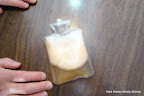
The principle is a bit like the pocket warmers we send the kids to school with in the winter. You put them in a pan of hot water until they melt. They stay molten in your pocket until you need the heat, and when you do, you click the metal strip inside. This causes the liquid to freeze, and in the process release a lot of heat. You can see the liquid freezing in the photos, taken in rapid succession. Somewhat counterintuitively, they are giving out heat when they are freezing, and taking in heat when they melt. Because of hysteresis, the freezing point is a little bit lower than the melting point. Water will freeze when it is below freezing, and ice will melt when it is above freezing. Some hysteresis is very helpful because we want heat when it gets colder, and we want heat to be taken away when it is hotter. As long as the liquid is not interrupted, its temperature can cool well below the freezing point, which I guess is a little over 40 degrees C. It's ready to freeze, though, just like the moisture is ready to freeze in the cold winter air. There needs to be a catalyst for the molecules to solidify around, and a clicked metal strip will act as that. Then the molecules will all freeze onto each other, like a rapidly growing crystal. A bit like snow crystals growing from the moisture in the air. As the molecules freeze, they release heat, warming up your pocket. I guess snow is releasing heat too, if the flakes are growing and taking moisture from the air. Perhaps that's why it feels warmer when it snows. I'm not sure whether snow counts as a phase change building material. You'd have to ask an Inuit. One possibility for using PCMs in the house was inside the hot water tank. Effectively the hot water tank has a load of wax floating around in it. When heat is coming into the tank from the solar panels, the wax gradually melts, absorbing the heat but staying around its melting point. When hot water is drawn out of the tank, the water cools, forcing the wax to freeze and release heat in the process, just like the pocket warmer. The combination of hot water and PCMs floating around in it, is very effective for increasing the thermal mass of water, and avoiding some of the issues of PCMs such as super-heating and hysteresis. I suggested that we use a hot water tank with PCMs when we were negotiating with the Solar thermal people, but they didn't seem to understand what I was talking about. I may as well have been suggesting that we build the foundation out of blancmange. Perhaps it was my language inability, or it may have been their reluctance to grasp the science. It was probably their stance as experts preventing them from listening to a technical opinion from a potential customer. |
This is one of the tanks that I would have liked to get for our solar thermal system, which works on the same system. I suggested this to the people who were trying to sell us the solar thermal system, but they didn't seem to understand.
Another interesting idea with PCMs is this one from China. Solar vacuum tubes are filled with phase change material. When the sun shines they change phase and charge up. When you run water through them, they draw off the heat and charge down.
So the pieces are all there. They are just scattered around on the floor rather than coming together into the plans of buildings.

Saturday, 29 September 2012
Prince Pondicherry and the Phase Change Palace
Those familiar with the works of Roald Dahl, or even just the Johnny Depp film, will no doubt remember Prince Pondicherry, who had a palace in India made out of chocolate. Every part was made from chocolate. Even the taps, from which would flow hot chocolate. Mister Wonka did warn the prince that he should start eating quickly as it would likely melt in the heat of summer, which sure enough it did.
A couple of pages before this palace is mentioned, Dahl tells us that Willy Wonka could make ice cream that wouldn't melt, even in hot sunshine. So the obvious question is, why not make a tropical palace out of chocolate that didn't melt?
The only sensible answer is that he was using the phase change of chocolate to maintain room temperature in the palace. While the phase changes of water, at zero degrees to ice and 100 degrees to steam, are too high and too low for a comfortable ambient climate or efficient heat production, chocolate changes its phase at a much more useful temperature.
The melting point of the best chocolate is around 34 degrees Celsius. This is an ideal temperature from a culinary perspective as it is low enough to melt in your mouth and high enough not to melt in your pocket. Unlike water, which is predominantly H2O molecules, chocolate contains a variety of substances in various forms of crystalinity, so the melting point will vary. The art of great chocolate making is to get the right kind of crystals of fat in there, but hearing about this suddenly makes its taste much less appealing.
There's also likely to be a lot of hysteresis. This means that it may melt at 34 degrees, but you have to cool it down below 28 degrees to get it to solidify again. I usually put it in the freezer.
So if Mr Wonka, who elsewhere exhibits a great mastery of the physical sciences, was indeed trying to make a phase change building, it would work something like this.
The temperature inside would stay below the melting point of the chocolate. On a hot day the chocolate would start melting. As it melted, it would absorb heat from its surroundings, therefore having a cooling effect. Later, the melted chocolate would solidify, emitting heat into the inevitable coolness of the night.
If he was trying to make a phase change palace, though, he didn't do a very good job, and shouldn't really have been advising Prince Pondicherry to eat this thermodynamic wonder.
In the winter, chocolate could work in the opposite way, absorbing heat from the sun in the day time, and melting in the process. As it cooled later inside the building, it would solidify and release heat as it changed its phase. The best thing to do with this chocolate would be to line a south-facing internal wall with it, so that it would catch the sun coming through south-facing windows. Painting a wall with chocolate is probably not to be recommended as it would run down the wall when it melted, and all end up at the bottom. Fixing chocolate in sealed bars, preferably in heat-absorbant black, would be much more effective.
And if it got really cold, you could always eat the chocolate.
A couple of pages before this palace is mentioned, Dahl tells us that Willy Wonka could make ice cream that wouldn't melt, even in hot sunshine. So the obvious question is, why not make a tropical palace out of chocolate that didn't melt?
The only sensible answer is that he was using the phase change of chocolate to maintain room temperature in the palace. While the phase changes of water, at zero degrees to ice and 100 degrees to steam, are too high and too low for a comfortable ambient climate or efficient heat production, chocolate changes its phase at a much more useful temperature.
The melting point of the best chocolate is around 34 degrees Celsius. This is an ideal temperature from a culinary perspective as it is low enough to melt in your mouth and high enough not to melt in your pocket. Unlike water, which is predominantly H2O molecules, chocolate contains a variety of substances in various forms of crystalinity, so the melting point will vary. The art of great chocolate making is to get the right kind of crystals of fat in there, but hearing about this suddenly makes its taste much less appealing.
There's also likely to be a lot of hysteresis. This means that it may melt at 34 degrees, but you have to cool it down below 28 degrees to get it to solidify again. I usually put it in the freezer.
So if Mr Wonka, who elsewhere exhibits a great mastery of the physical sciences, was indeed trying to make a phase change building, it would work something like this.
The temperature inside would stay below the melting point of the chocolate. On a hot day the chocolate would start melting. As it melted, it would absorb heat from its surroundings, therefore having a cooling effect. Later, the melted chocolate would solidify, emitting heat into the inevitable coolness of the night.
If he was trying to make a phase change palace, though, he didn't do a very good job, and shouldn't really have been advising Prince Pondicherry to eat this thermodynamic wonder.
In the winter, chocolate could work in the opposite way, absorbing heat from the sun in the day time, and melting in the process. As it cooled later inside the building, it would solidify and release heat as it changed its phase. The best thing to do with this chocolate would be to line a south-facing internal wall with it, so that it would catch the sun coming through south-facing windows. Painting a wall with chocolate is probably not to be recommended as it would run down the wall when it melted, and all end up at the bottom. Fixing chocolate in sealed bars, preferably in heat-absorbant black, would be much more effective.
And if it got really cold, you could always eat the chocolate.
Monday, 24 September 2012
Phase change materials - an introduction
Under the category of things we thought about doing, didn't, and now wish that we had, comes PCMs, or phase change materials. You probably think you don't know what they are, but I'm sure you have used them many times. The planet has also been using them to stabilise its climate, although perhaps it won't be for much longer. In fact that I'm just talking about one phase change material: ice.
We should probably also call it water, as the point of phase change materials is that they change from one phase to another, for example ice turning to water, steam condensing to water, or dry ice subliming into gaseous carbon dioxide. What is happening in all these cases is a transaction of heat at well above the regular exchange rate per degree change in temperature.
Some languages don't have separate words for the different phases of water. For example, Malay apparently has the word air for water, confusingly enough, and air batu, roughly "solid water" for ice. Strong evidence for the Sapir Whorf theory that language depends on culture. Japanese, on the other hand, has four words for di-hydrogen oxide. Kohri is ice, mizu is cold water, (o)yu is hot water and jouki is steam. Actually you could argue that jouki is not really one word, but two Chinese characters, hence as foreign a concept as when Malay speakers say aisu. But I digress.
The beauty of phase change materials is that they save up heat, either in credit or in debt, and release it at a constant temperature. So when you put some ice cubes in a gin and tonic, you're ensuring that the temperature of the beverage, as it reaches your lips, will be the same from the moment it reaches the table, until the last drop pours out of the rattling ice. That is as long as you finish drinking it before the ice melts. My grandmother was never a big fan of ice as it diluted the alcohol. I seem to be digressing again.
What is happening in your gin and tonic, or even lemonade, is that the ice, being ice, stays at around zero degrees centigrade. If you work in the Farenheit system, then all you need to know is that zero corresponds to the freezing point of water and 100 to the boiling point. The glass and liquid in it set up some kind of equilibrium so that the temperature of the water is between room temperature and ice temperature. Heat, dutifully obeying the second law of thermodynamics, flows into the liquid from outside, leaving drops of sweat from condensed airborne humidity in its wake. It then flows from the water into the ice. Rather than changing the temperature of the ice, part of it changes from ice into water.
On a molecular level, this means that rather than sitting in neat rows, either in starry crystals or glass-like blocks, those di-hydrogen oxides are all getting up and boogying around. Getting them all up takes a lot of energy. When they all sit down in their neat rows again, that energy is released. A similar level of energy is needed to change them from the pedestrian liquid state, where the molecules are at least in close proximity with each other, to the jet-set gaseous state where they fly around at great distances to each other.
The United States have been instrumental in the propagation of ice around the planet. In the nineteenth century there was a huge trade harvesting ice from New England lakes and transporting it as far afield as India and Australia. This trade was finished off by the 1920s at the hand of plant ice, based on technology that went in to the refrigerator that became a part of every kitchen from the 1930s in the US, and in later decades around the world.
As a phase change material, ice works by first having the heat taken out of water, either in a cold winter or with the refrigerating cycle of a heat pump. Later it absorbs heat from its environment, bringing down the temperature accordingly. Steam can also work in the opposite way, as used in heating systems of large buildings, taking in heat when the water evaporates in the boiler, and releasing heat when it condenses in radiators around the building.
As a phase change material for buildings, water is rather limited as the freezing point, zero degrees C, is much too cold for the building, and the boiling point, 100 degrees C, is much too hot. There are other materials with melting points around ambient temperature, for example chocolate. More about that later.
Subscribe to:
Posts (Atom)