Monday, 16 January 2017

Friday, 13 January 2017
Do they know what they are talking about? Questions to ask your architect
Are you looking for someone to build a low energy house? Are you worried that they don't know what they are talking about. You probably should be! Here are some questions you can ask to find out. Check their answers with the handy key below, and find out whether you're in safe hands, or whether you should think twice about letting them build a kennel for your pet husky.
1. I'm interested in Passive House. Can you build one?
 a) I can build anything!
b) Oh yes, passive solar. That's when you just use energy from the sun to heat the house.
c) I've heard of Passive House, but I'm not exactly sure what you need. I'll find out.
d) Yes, I'd really like to build a Passive House.
2. We're thinking about the layout of the house and wondering where to put the bathroom.
 a) Oh, you can put it anywhere.
b) It should be on the South side of the house so the sun will get in through the windows and keep it warm.
c) It should be on the North side of the house because it'll be warm anyway and doesn't need south-facing windows.
d) The important thing is to keep hot water pipes as short as possible. You should try to keep the bathroom, kitchen and washing machine close to each other or in the room immediately above or below, and have the hot water source near.
 |
| German scam! |
3. These high performance windows seem really expensive, are they worth it?
a) No, they're a German scam.
b) Yes [aside] I'm being paid by percentage.
c) No, you can just add more insulation in the walls.
d) I know they are expensive, but yes, they usually are worth it for the lower levels of heat loss and higher levels of comfort, unless you want to live in a cave!
4. For the ventilation system, which do you think is better, heat recovery ventilation or energy recovery ventilation? Heat recovery ventilation transfers the heat of outgoing air into the incoming air, while energy recovery ventilation also transfers the humidity.

a) Ventilation? What do you want that for? If you want fresh air, you can just open a window.
b) The best ones are made by the company we always use.
c) People here usually have energy recovery.
d) That's a good question. There are advantages and disadvantages to both.
 |
| Yes, inside |
a) Boiler inside? Ha ha ha ha ha ha. That's a good one!
b) We always put the boiler outside. There's no space inside, and it will make the house too hot in the summer.
c) That's an interesting idea. Those things do lose a lot of heat, and it gets pretty cold here in the winter.
d) Yes, I know. I think that's because people are still following building practices from before the invention of air conditioning and insulation and hark back to a time when people didn't live long enough to die of cold in poorly-built houses.
6. How much more expensive will it be to make a low energy house?
a) It'll be really expensive. We make really good houses already and there's no point in spending more money on this nonsense.
b) It won't make any difference to the cost.
c) I'm not sure, we'd have to work out what extra time and materials are involved, then calculate the extra price.
d) It'll probably put between 5 and 20 percent on your budget. Keeping costs down is a big challenge which the building trade really needs to work on. But the extra costs will pay for themselves within a few years in lower heating costs, and you'll have a more comfortable, healthier house that should last longer, so it's a price well worth paying.
Answer key:
Mostly a): Keep looking! The building trade is well known for its conservatism and you seem to have found a perfect example.
Mostly b): He (probably a he) doesn't really know what he's talking about, and probably doesn't realise. Or perhaps he assumes you know nothing, and is eagerly waiting to separate you and your money.
Mostly c): They don't have a lot of experience with low-energy building, but sound willing to find out and may be a good person to work with.
Mostly d): This sounds like a great person to build a low energy house.

Saturday, 7 January 2017
Five years of solar power!
Our Suntech display panel congratulated us the other morning on five years of generating solar power. We've made over 60 Megawatt hours. That would keep a 60 watt light bulb going for over a hundred years. But we don't have any 60 watt light bulbs, they're all low-power leds.

In the same period we've used under 30 Megawatt hours. Around 45% of what we have generated. We sold around 90% of the electricity we generated, and bought around 75% of the electricity we used. I'm not sure how much sense this makes in environmental terms or for overall energy usage, but economically it makes sense since we only pay 11 yen for off-peak electricity, and they have been paying us 48 yen per KiloWatt hour for our solar power, totaling over 3 million yen.
Our contract lasts for another five years, and we will see what is available at the end of that. In the meantime I can start working on my plan to use the hot air under the panels for our atmospheric heat pump, rather than the frigid night air. I think it will take that long to find a brave enough heat pump engineer to tackle the project, or to learn enough about heat pumps to try it myself.
(Corrected 10th January: originally said "Gigawatts", changed to "Megawatts". We're not a nuclear power station!)
Wednesday, 21 December 2016
Why are Japan's building energy standards low and lax compared to Northern Europe?
Just looking back over some homework. After a lesson last year on building standards, including comparisons between standards in Japan and Europe, I asked my students this question: Why do you think Japan's building energy standards are low and lax compared to Northern Europe?
(The letters afterwards correspond to the nationality of students. See below for a key.)
(The letters afterwards correspond to the nationality of students. See below for a key.)
Some of them commented on the climate, for example:
The Japanese Archipelago extends from north to south, and Japanese climate has more variety than Northern Europe. Japan region has its shape long from the North to the South, (not like Denmark, UK), It has a really cold winter like in Hokkaido, but most of the population is located in the warmer place like Tokyo, Osaka. (K, J1, V)
Northern Europe has a higher latitude than Japan. That means the winter is colder so for the very survival of the people they need to be concerned about building houses which will lose less heat. There comes the idea of low energy building. The example is same as Australia and Sweden when we compare the death rate from cold. (B)
Because, the climate change of Japan is more irregular than Northern Europe. When every season changes, temperature of Japan is changeable. (K)
There's a lot of earthquakes and typhoons in Japan. Rather than focusing on energy saving, Japanese focus more on preventing their house from getting blown away by typhoon or getting crushed by earthquake. (M)
There's a rumour in Malaysia that Japanese tend to build cheaper and simple house, so that when natural disaster comes, they won't have much loss even when their house is crushed, and they could have their house rebuilt in a shorter period. (fast, easy, and cheap) (M)
Northern Europe has a higher latitude than Japan. That means the winter is colder so for the very survival of the people they need to be concerned about building houses which will lose less heat. There comes the idea of low energy building. The example is same as Australia and Sweden when we compare the death rate from cold. (B)
Because, the climate change of Japan is more irregular than Northern Europe. When every season changes, temperature of Japan is changeable. (K)
There's a lot of earthquakes and typhoons in Japan. Rather than focusing on energy saving, Japanese focus more on preventing their house from getting blown away by typhoon or getting crushed by earthquake. (M)
There's a rumour in Malaysia that Japanese tend to build cheaper and simple house, so that when natural disaster comes, they won't have much loss even when their house is crushed, and they could have their house rebuilt in a shorter period. (fast, easy, and cheap) (M)
Old building ways focus on summer (even though low energy building would help them in summer too) (P)
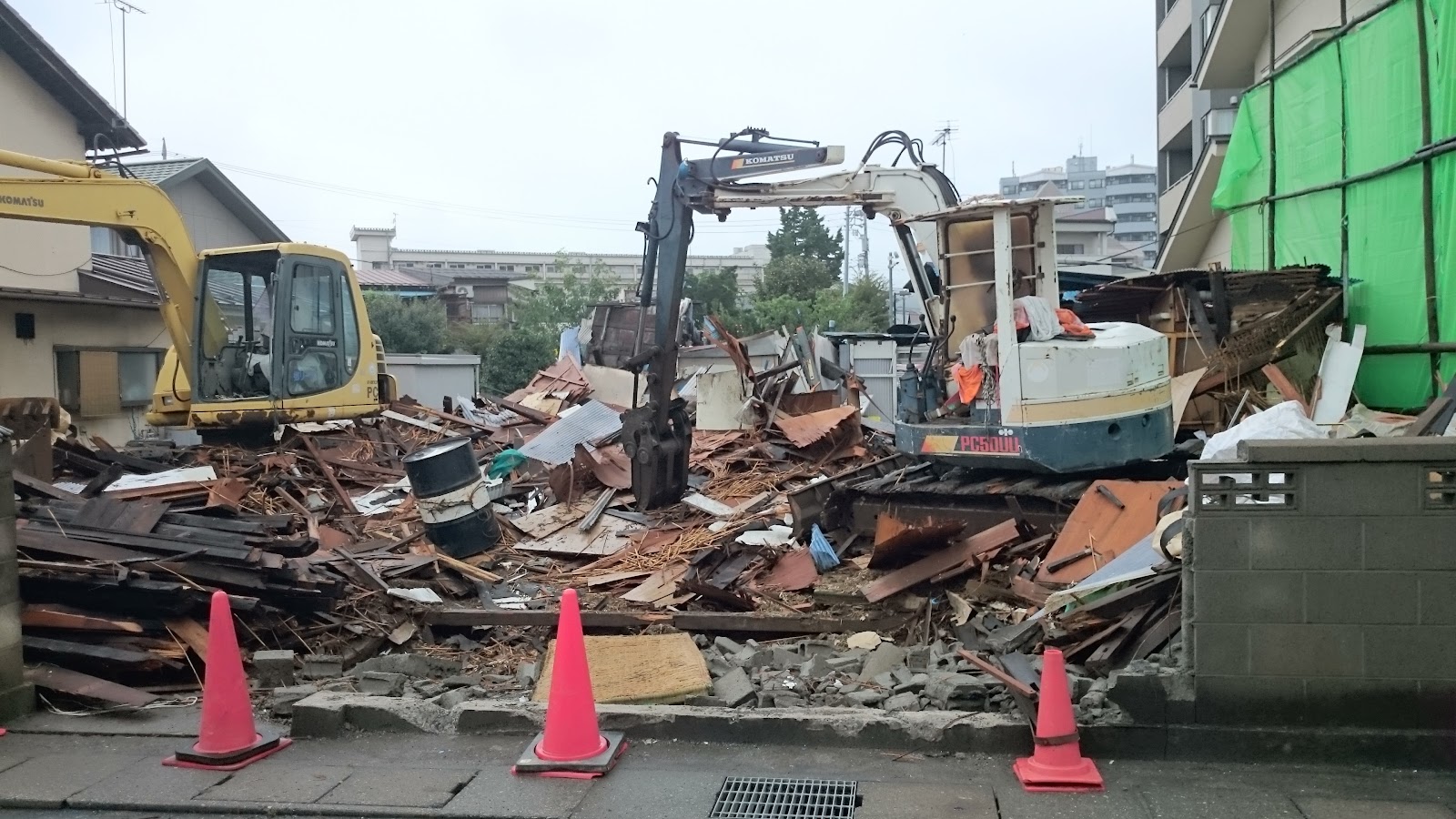 |
| Typical 1960's Japanese house (!) |
They also commented about building industry:
The Japanese tend to treasure their own traditional buildings and they are not flexible to accept new standards. (J2)
The Japanese tend to treasure their own traditional buildings and they are not flexible to accept new standards. (J2)
Often demolishing old houses and building new ones instead (not enough time for payback of a more expensive to build low-energy house) (P)
And they made comments about Japanese culture:
I think that there is cultural differences. Japanese have table known as kotatsu and they love it, They usually prepare to stay in kotatsu rather than keeping the whole house warm. Therefore they aren't paying any attention towards the overall warmth of the building. (M)
Culture of shouganai [there's nothing we can do about it] and 'living with nature' (P)
They are patient to changes of season because Japanese island has basically the four seasons and it means they don't need to employ efficient standards because of their acquired patience. (J2)
Culture of shouganai [there's nothing we can do about it] and 'living with nature' (P)
They are patient to changes of season because Japanese island has basically the four seasons and it means they don't need to employ efficient standards because of their acquired patience. (J2)
They also mentioned population and technology.
Northern European specially Scandinavian countries have way less population than Japan. When you have more people, the matters you need to worry about increase by number. Also it takes time to solve them. I think that is another reason of having a less standard. (B)
Japan try to reduce a consumption of primary energy by installing housing equipment. (J3)
(B: Bangladesh; J: Japan; K: South Korea; P: Poland; V: Vietnam)
This year I just asked a multiple choice question. Fifteen students gave answers. The number of responses is in brackets.
"In your opinion, what is the biggest reason for Japan's lax low-energy building standards? (There is no correct answer. I'm just interested what you think!)"
Scandinavian countries have a similar climate, but Japan is an archipelago going from very hot places to cold places. (4)
Creating low-energy electrical appliances and products is more important for Japan's economy. (3)
Northern European buildings are built for the cold winters, but Japanese buildings are built for the hot summers. (3)
Japanese builders like traditional buildings, and they do not want to change. (1)
All of these reasons are equally important. (1)
Some other reason. (Please tell me next lesson!) (1)
Because of earthquakes and other natural disasters, Japanese people do not want to spend a lot on buildings. (0)
I don't know. (2)
Northern European specially Scandinavian countries have way less population than Japan. When you have more people, the matters you need to worry about increase by number. Also it takes time to solve them. I think that is another reason of having a less standard. (B)
Japan try to reduce a consumption of primary energy by installing housing equipment. (J3)
(B: Bangladesh; J: Japan; K: South Korea; P: Poland; V: Vietnam)
This year I just asked a multiple choice question. Fifteen students gave answers. The number of responses is in brackets.
"In your opinion, what is the biggest reason for Japan's lax low-energy building standards? (There is no correct answer. I'm just interested what you think!)"
Creating low-energy electrical appliances and products is more important for Japan's economy. (3)
Northern European buildings are built for the cold winters, but Japanese buildings are built for the hot summers. (3)
Japanese builders like traditional buildings, and they do not want to change. (1)
All of these reasons are equally important. (1)
Some other reason. (Please tell me next lesson!) (1)
Because of earthquakes and other natural disasters, Japanese people do not want to spend a lot on buildings. (0)
I don't know. (2)
Some of these answers are interrelated, so the question doesn't really lend itself to the multiple choice format. Looking back on it, the most commonly selected answer doesn't clearly answer the question. I guess the implication is that Japan's varied climate makes it difficult to set single standards. I'll have to try again next year! Perhaps they should be able to give ratings to several different reasons.
Tuesday, 13 December 2016
Is that factoid true?
I came across this comment as I was preparing a lesson on cooling:
"US uses more electricity on cooling than Africa does on everything."
As often happens, the factoid gets divorced from its source, and just stays there, overly confident in its truth. But is it true? And how do I find out? As Churchill said, "A lie gets halfway around the world before the truth has a chance to get its pants on." He said this long before the internet was invented and the term "social media" was coined, but some things do not change. Or perhaps, and somewhat more scarily the world today is similar to the 1920s, and we are heading towards a repeat of the 1930s.
According to this article in Mother Jones (July, 2015), the US spends 11 billion dollars on air conditioning, and in the process emits 100 million tons of CO2.
According to the Carbon Dioxide Information Analysis Centre (2008) Africa's carbon emissions 311 metric tonnes. But that's all emissions, not just electricity.
Wait a minute, was the Mother Jones statistic metric tonnes, long tons or short tons? The latter are 10% more or less the former. Also, the factoid said "electricity" and Africa presumably has other carbon emissions than electricity. So it may be true.
According to accountants KPMG, Africa's electric generation capacity was 680 billion kWh in 2012. The US average 12 cents per kWh. So, I can work back from the 11 billion dollars to get 90 billion kWh. Now we're even further out and Africa is using over seven times more energy for everything than the US does for cooling.
US Energy Information Administration's website gives around 2 pounds CO2 per kWh of electricity. If a short (US) ton is 2000 pounds, that's 1000 kWh per ton of CO2. So 100 billion kWh on air conditioning in the US.
Interestingly, if the above emission figures are correct, Africa's energy generation is at least twice as clean as the US. This is possible if Africa has a higher proportion of hydroelectricity, and a lot of the plant is newer and more efficient.
Or perhaps this factoid was just talking about domestic air conditioning, rather than commercial or industrial.
 |
| This is neither US nor Africa, but may have some air conditioning |
But where did I actually get that factoid from in the first place? It probably came from this July 2012 article on Yale Environment 360 by Stan Cox. It was probably true at some point, since the US has a long history of air conditioning, and Africa is still rapidly developing as an electricity consumer.
Oh for that world of long ago, when all good things were true...
Subscribe to:
Posts (Atom)